Home About Us IPDS Team Advisory Board Partners Programs International Young Diplomat School Emerging Young Women Leaders Congress International Certification Programs Research & Publications Centres of Study Central Asia & Eurasia Women, Peace & Leadership Leadership Center SCO Studies BRI & China Studies European Studies American Studies Events Insights Career Support Contact Us

Category: Weekly briefs

  • Shanghai Cooperation Organisation at 25

    Shanghai Cooperation Organisation at 25

    IPDS Insight

    SCO at a Glance

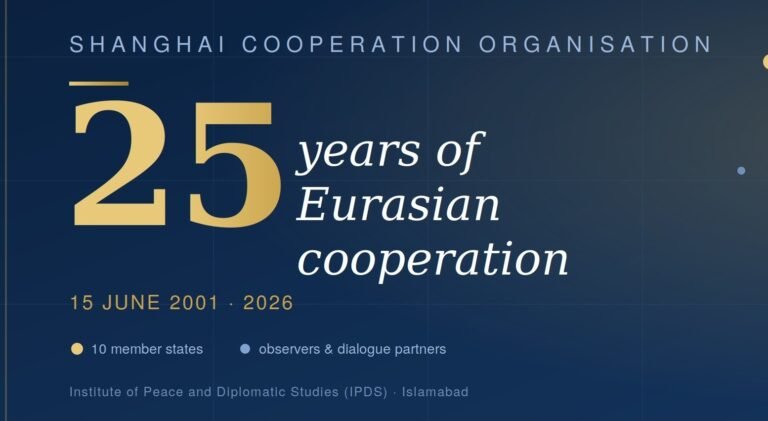
    The Shanghai Cooperation Organisation turned twenty-five on June 15, 2026. It was founded in Shanghai on that date in 2001 by China, Russia, Kazakhstan, Kyrgyzstan, Tajikistan, and Uzbekistan, evolving out of the earlier “Shanghai Five” security mechanism that had brought these states together after the Soviet collapse to manage border disputes and the threat of separatism, terrorism and extremism in Central Asia.

    A quarter-century later it has grown into the largest regional organisation in the world by both population and geographic coverage, encompassing roughly forty percent of humanity and close to a quarter of global GDP.

    It is the first regional multilateral body co-founded and named after a Chinese city, and it remains the institutional core of what Beijing and Moscow describe as a multipolar alternative to Western-led security and economic architecture.

    The SCO today operates on three structural pillars: security cooperation through its Regional Anti-Terrorist Structure (RATS) based in Tashkent; economic and connectivity cooperation, increasingly anchored around a proposed SCO Development Bank; and people-to-people and cultural exchange, including youth, education, and tourism initiatives.

    Its full members coordinate joint counter-terrorism exercises, intelligence-sharing arrangements, and increasingly since 2025, frameworks for digital economy and artificial intelligence cooperation, which now sit alongside traditional infrastructure and energy cooperation as core priorities of the bloc’s next decade.

    Expanding Partner Network

    Belarus’s accession on July 4, 2024 at the Astana summit brought full SCO membership to ten states , the first time a European country joined, and a milestone Beijing and Moscow both presented as proof that the organisation’s relevance extends beyond Asia.

    As of June 2026, there has been no further expansion of full membership beyond these ten; the organisation’s growth since Belarus has instead come through its dialogue partner network, which now includes the Lao People’s Democratic Republic, accepted at the September 2025 Tianjin summit, alongside Sri Lanka, Turkey, Cambodia, Azerbaijan, Nepal, Armenia, Egypt, Qatar, Saudi Arabia, Bahrain, Kuwait, Myanmar, the Maldives and the United Arab Emirates.

    Turkey, despite years of speculation about full membership, remains a dialogue partner only , a status that has not changed as of this report.

    Who Runs the SCO: Chairmanship and Secretariat

    Two distinct leadership tracks operate inside the SCO, and conflating them is the most common error in casual coverage.

    The rotating chairmanship is a one-year political chair held in turn by a member state, determined by Russian-alphabetical order of country names, and it confers the right to host that year’s Heads of State summit and shape its agenda.

    The Secretary-General is a fixed three-year administrative post based at the SCO Secretariat in Beijing, responsible for the organisation’s day-to-day functioning independent of whichever state holds the chair.

    Rotating Chair Kyrgyzstan (President Sadyr Zhaparov) Took over from China at the September 2025 Tianjin summit; term runs through the 2026 Bishkek summit. Chairmanship slogan: “25 Years of the SCO – Place for Peace and Prosperity.”

    Secretary-General — Nurlan Yermekbayev (Kazakhstan) Kazakh diplomat, in post as SCO Secretary-General; reaffirmed at the June 15, 2026 Beijing anniversary reception that the milestone “symbolises decades of dedicated work” under the Shanghai Spirit framework.

    Oleg V. Kopylov (Russia): Deputy Secretary-General used the 25th anniversary platform to argue the organization has evolved beyond its original border-security mandate toward broader “functionality, rising potential, and increasing well-being” goals.

    Kyrgyzstan’s chairmanship priorities for 2025–26, presented formally in October 2025, center on three goals: deepening security coordination against terrorism, separatism, and extremism; accelerating the financial architecture of the bloc—specifically the long-discussed SCO Development Bank, Development Fund, and Investment Fund; and advancing Bishkek’s own “SCO Green Belt” environmental initiative, presented at the April 3, 2026, meeting of heads of SCO environmental agencies in Bishkek.

    The Council of National Coordinators, the senior working body that prepares summit agendas , met in Beijing in late January 2026 and again in Osh on March 16, 2026, both sessions chaired by Kyrgyzstan and focused on translating the Tianjin Declaration’s commitments into implementable programs ahead of the Bishkek summit.

    Tianjin Summit Legacy: What Was Actually Decided

    The most important recent SCO summit was held on August 31–September 1, 2025, in Tianjin, China , the 25th meeting of the Council of Heads of State and the largest SCO summit in the organization’s history, attended by leaders from more than twenty countries and the heads of ten international organisations, including UN Secretary-General António Guterres.

    It was also the first Heads of State summit held at the SCO’s full current membership of ten states. Leaders adopted twenty-four outcome documents in total, the centrepiece being the Tianjin Declaration and the SCO Development Strategy for 2026–2035, a ten-year roadmap that for the first time formally integrates artificial intelligence and the digital economy as core pillars of regional cooperation alongside traditional security and trade priorities.

    President Xi Jinping used the summit to unveil his Global Governance Initiative , the fourth in a sequence of landmark Chinese global initiatives following the Global Development Initiative, the Global Security Initiative, and the Global Civilization Initiative.

    The GGI rests on five stated principles: sovereign equality, adherence to international law, genuine multilateralism, a people-centred approach, and a focus on practical action over declaratory diplomacy.

    This is Beijing’s most explicit attempt yet to offer an alternative framework to the US-anchored post-1945 international order, through the SCO as the launch platform precisely because it allowed China to make the pitch surrounded by Russia, India, Iran and seven other states rather than unilaterally.

    The single most concrete institutional outcome was the decision to move forward on establishing an SCO Development Bank, intended to finance regional infrastructure and economic development projects, with a particular mandate to serve landlocked Central Asian economies such as Kazakhstan and Uzbekistan that have long struggled to access affordable project financing through Western-led institutions.

    Additional agreements at Tianjin created an SCO Anti-Drug Center and a Universal Center for Countering Challenges and Threats to the Security of SCO Member States, both expansions of the bloc’s original counter-terrorism mandate. The CIS — the Commonwealth of Independent States , was simultaneously granted SCO observer status, deepening the institutional overlap between the SCO and the post-Soviet space’s other major multilateral body.

     SCO Development Bank: Progress and the De-Dollarizationn Question

    As of June 2026, the proposed SCO Development Bank remains in active consultation rather than operational reality, but momentum has built steadily since Tianjin.

    Through the spring of 2026 indicates SCO finance ministers and central bank officials have made what is being described as substantive progress, alongside a parallel agreement to establish an SCO financial and economic think tank network to support the bank’s eventual design.

    The 2026 SCO budget and amendments to the bloc’s financial regulations were formally signed earlier this year as procedural groundwork. The central unresolved question, is currency denomination: Russia and China are pushing for the bank to settle a meaningful share of its transactions in national currencies rather than the US dollar, continuing the de-dollarisation push both countries have pursued bilaterally since Western sanctions on Moscow began in 2022.

    Kyrgyzstan, as chair, has made accelerating this institution one of its three formal chairmanship priorities for 2025–26, alongside continued discussion of a complementary SCO Development Fund and Investment Fund.

    25th Anniversary : What Happened in June 2026

    The anniversary date of June 15 was marked across multiple cities rather than with a single central event, reflecting the SCO’s now-distributed institutional footprint.

    On June 9, the Shanghai Academy of International Studies convened an international conference titled “The 25th Anniversary of the Shanghai Cooperation Organisation: New Challenges and New Steps in Global Governance,” bringing together think-tank representatives from China, Kazakhstan, Russia and Uzbekistan alongside SCO Secretariat staff.

    SCO Secretariat Advisor Siarhei Viarheichyk used the platform to outline three institutional priorities for the organisation going forward: improving operational efficiency, enhancing internal governance structures, and adapting the SCO’s treaty and legal framework—much of it unchanged since 2001 to contemporary conditions.

    On June 15 itself, Beijing hosted the marquee diplomatic reception, attended by representatives from member states, observer states, dialogue partners, Chinese officials, and a wide cross-section of business, civil society and media figures.

    Chinese Foreign Minister Wang Yi used the occasion to credit SCO member states with advancing equality and justice through counterterrorism cooperation and peaceful conflict resolution, and to reaffirm the SCO’s status as a diplomatic priority for Beijing. Secretary-General Yermekbayev’s anniversary statement struck a deliberately commemorative tone, framing the milestone as proof of the durability of consensus-based cooperation among states with historically divergent interests a notable line given that two of the bloc’s members, India and Pakistan, retain an active border dispute, and a third, Iran, remains in active confrontation with the United States.

    The SCO Secretariat separately announced the winners of a student essay contest held to mark the anniversary, a minor but illustrative example of the organisation’s growing investment in youth and soft-power programming alongside its security and economic core.

    What Comes Next: The Road to the Bishkek Summit

    Kyrgyzstan’s current chairmanship, running under the theme of marking twenty-five years while building toward the organisation’s next decade, will culminate in a Heads of State summit in Bishkek that carries unusual symbolic weight: it will be the first SCO summit hosted by Kyrgyzstan since the country’s founding membership in 2001, and the first anniversary-adjacent summit to be chaired by a Central Asian state rather than China or Russia.

    Bishkek’s stated chairmanship priorities , accelerating the Development Bank, Development Fund and Investment Fund architecture, deepening counter-terrorism coordination, and advancing an environmental “SCO Green Belt” initiative unveiled at an April 2026 meeting of member-state environmental agencies, are a deliberate way to convert the Tianjin Declaration’s ambitious paper commitments into operating institutions before the chairmanship rotates again.

    Whether that conversion succeeds will be the most meaningful test yet of whether the SCO’s newer financial architecture can function as more than a platform for great-power initiative, and whether a quarter-century-old institution built to settle a border dispute can credibly claim, in its second quarter-century, to be building the financial and digital infrastructure of a genuinely multipolar Eurasia.

    The Council of National Coordinators met in Beijing in late January and in Osh in March, and an SCO Youth Digital Forum is scheduled for June 4–5, 2026, in Bishkek as part of the broader run-up programming. Council of Heads of State, is scheduled to take place in Bishkek on August 31 – September 1, 2026,

    What is not in serious dispute, twenty-five years on, is that the organization has outgrown every previous external prediction of its irrelevance or collapse. It has absorbed members with active territorial disputes against one another, sustained a security-coordination architecture across a region historically defined by mutual suspicion, built the largest population and PPP-weighted economic bloc among the world’s regional organisations, and is now attempting the considerably harder task of building financial institutions capable of operating independently of the dollar-denominated system that has anchored international development finance since Bretton Woods.