Centre Research · Live & Updated
Pakistan–United States Relations Tracker
Pakistan-US relations, historically defined by cycles of close security alignment followed by estrangement, have entered a period of active re-engagement since mid-2025 — anchored in a reciprocal tariff and trade framework, a landmark critical-minerals partnership, and a renewed counterterrorism dialogue. Trade is now the most substantively active dimension, with the US remaining Pakistan's largest single-country export market. This is a living reference, revised as new agreements, visits and data are published.
19%
US reciprocal tariff rate
$500M
Critical minerals agreement
Diplomatic Engagement
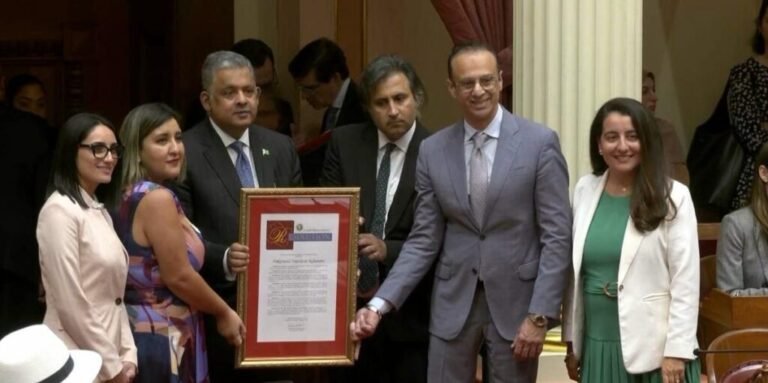
Engagement has broadened beyond the traditional executive-branch/military channel to include parliamentary diplomacy: a US congressional delegation including Rep. Ryan Zinke and Rep. Michael Baumgartner visited Islamabad in July 2026 for talks spanning trade, education, investment and institutional partnerships. (Mettis Global, Jul 2026)
Trade & Tariffs
Jul 2025: Pakistan negotiated a reduction of the US "reciprocal tariff" on its exports from an initially announced 29% to 19%, confirmed by US executive order on 31 July 2025 — a more favourable rate than India (25%), Bangladesh (20%) or Vietnam (20%). (Dawn, Express Tribune)
Jul 2026: Formal negotiations on a Pakistan-US Agreement on Reciprocal Trade were held in Washington (9–10 July), covering tariffs, market access and investment; both sides described "significant progress." (Express Tribune, Times of Islamabad)
Goods trade reached $9.4 billion in the last fiscal year, with the US as Pakistan's largest single-country export destination. Deputy PM/FM Ishaq Dar has stated Pakistan is "confident" bilateral trade can double to $20 billion within five years. (Dawn)
Critical Minerals & Investment
Sept 2025: Pakistan and US Strategic Metals signed MoUs under a $500 million critical-minerals agreement, following a three-phase development plan (Phase 1, 2025–26: exporting readily available minerals; later phases build refining capacity).
2 Oct 2025: Pakistan dispatched its first-ever shipment of rare earth and critical minerals to the US under the agreement — antimony, copper concentrate, and rare earths including neodymium and praseodymium. (PR Newswire, SFA Oxford)
Security & Defense Cooperation
The US-Pakistan Counterterrorism Dialogue has met annually, with rounds in Islamabad (12 Aug 2025) and Washington (4 Aug 2026, 4th round), both jointly naming the Balochistan Liberation Army (BLA), ISIS-Khorasan and Tehreek-e-Taliban Pakistan (TTP) as shared priority threats. (US State Dept, 2025, The Diplomat, 2026)
The US approved a $686 million sustainment and upgrade package for Pakistan's F-16 fleet (Block 52 and Mid-Life Upgrade variants), intended to keep the fleet operationally effective to 2040 and framed by Washington as strengthening counterterrorism interoperability. (The Media Line)
Joint counterterrorism exercise "Inspired Gambit-2026" — the 13th in a series running over a decade — was held in Punjab, Pakistan.
Multilateral & Economic Context
Separately from the bilateral track, Pakistan remains under a 37-month IMF Extended Fund Facility (approved Sep 2024) and a 29-month Resilience and Sustainability Facility (approved May 2025); the IMF's review completion in May 2026 released roughly $1.1B (EFF) and $220M (RSF). The US is the IMF's largest shareholder but this is a multilateral, not bilateral, facility. (IMF)
Pakistan has reportedly sought a bilateral exchange-stabilization support facility of up to $10 billion from the US Treasury — unconfirmed/under discussion as of this writing, not a concluded agreement. (Ynet News)
How to cite: IPDS Centre for American Studies, "Pakistan–United States Relations Tracker," Institute of Peace and Diplomatic Studies, last revised September 2026.
This is an early version of this tracker (first published September 2026) and will be expanded with further sourced detail over time. Spot an error or an update we've missed? Suggest a correction.