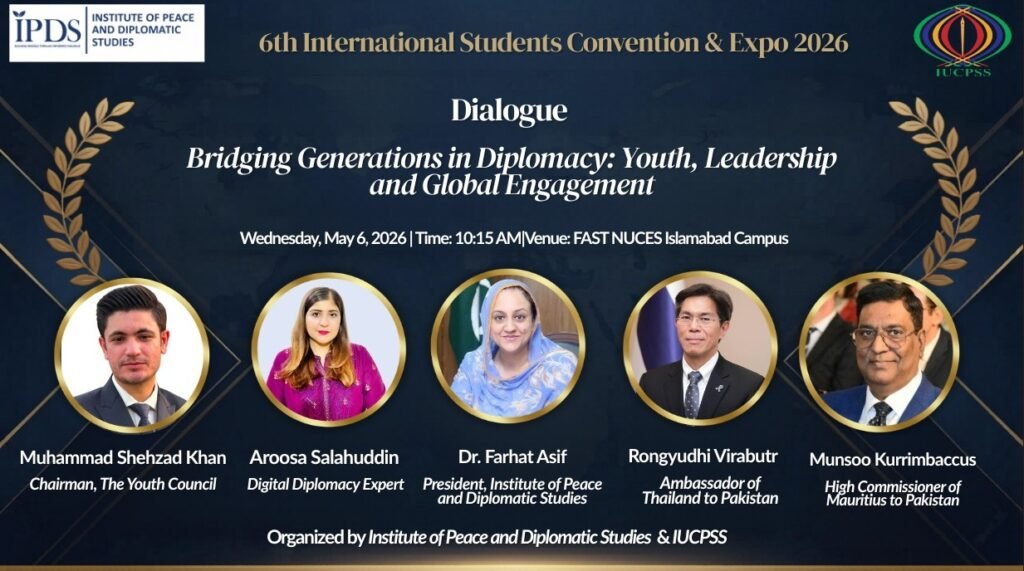
The Institute of Peace and Diplomatic Studies, in collaboration with the Inter University Consortium for the Promotion of Social Sciences, Humanities and Arts (IUCPSS)—a consortium of 80 universities across Pakistan—jointly organized a dialogue titled “Bridging Generations in Diplomacy: Youth, Leadership, and Global Engagement” at the 6th International Students Convention & Expo 2026.
The event was held at FAST-NUCES, Islamabad.
The dialogue brought together distinguished diplomats, academics, and youth leaders for an intergenerational conversation on the evolving role of diplomacy and the importance of collaborative global cooperation. The panel included:
- Rongyudhi Virabutr, Ambassador of Thailand to Pakistan
- Dr. Farhat Asif, President, Institute of Peace and Diplomatic Studies (IPDS)
- Munsoo Kurrimbaccus, High Commissioner of Mauritius to Pakistan
- Aroosa Salahuddin, Digital Diplomacy Expert
- Muhammad Shehzad Khan, Chairman, The Youth Council
Dr. Farhat Asif, who hosted the session, delivered the opening remarks and emphasized the need for collaboration between generations in diplomacy. She highlighted that no single generation holds complete solutions to today’s complex challenges and stressed the essential role of youth in advancing Sustainable Development Goals (SDGs) and participating in decision-making processes.
Ambassador Rongyudhi Virabutr urged the young audience to develop sustainable solutions that go beyond analytical thinking. He encouraged youth to take ownership of the future by creating their own solutions rather than depending solely on existing policies.
Digital diplomacy expert Aroosa Salahuddin spoke about the responsible use of social media, warning against its potential harm to society. She described diplomacy as a slow but impactful process that leads to thoughtful and inclusive outcomes, reminding the audience that “we are the leaders of the next generation.”
High Commissioner Munsoo Kurrimbaccus shared personal experiences and positioned himself as a “social practitioner.” He underscored the critical importance of diplomacy in the modern world and praised Pakistan’s diplomatic efforts in facilitating the ceasefire between the United States and Iran. He also noted the limited focus on diplomacy-centric education in contemporary times.
Muhammad Shehzad Khan, Chairman of The Youth Council, pointed out that when young people are excluded from state decision-making, policies are imposed upon them rather than shaped with their input.
He advocated for the adoption of a reverse mentoring model in Pakistan, similar to practices in Singapore, where youth can contribute through digital platforms while gaining practical experience in diplomatic processes such as drafting resolutions.
In the interactive question-and-answer session, the panel collectively encouraged young participants to actively create shadow policies, use social media for effective advocacy, and claim their space in diplomatic discourse through all available platforms.
The dialogue successfully highlighted the importance of intergenerational participation in addressing global challenges and shaping a more inclusive approach to diplomacy.