Resilience and Rupture: Institutional Limits of Knowledge Diplomacy in Pakistan–Italy Relations, 1948–1999
Written by Sajida Khalid
Twentieth‑century diplomacy is often framed through military coalitions, ideological divides and the familiar statistics of trade. This narrative rarely acknowledges the subtle, knowledge‑driven channels through which many states sustained their international relationships. Channels that proved resilient for decades but ultimately strained under shifting geopolitical and administrative pressures.
The Pakistan–Italy partnership from 1948 to 1999 is one such example, a bilateral relationship held together not by commerce or security alignments but by enduring scientific and cultural cooperation.
Italy and Pakistan entered the Cold War from different yet equally constrained strategic positions. Italy sat on NATO’s southern maritime flank, bound by alliance obligations and Mediterranean security pressures.1. Pakistan, meanwhile, became a frontline state in South Asia, bound to Western defence pacts and exposed to the turbulence of the Afghan frontier.2 These structural pressures meant that Pakistan-Italy diplomatic agendas were driven less by bilateral initiative and more by the hard‑security demands of coalition politics and recurring regional crises.
Against this backdrop of alliance obligations and recurring regional crises, a layer of soft‑power cooperation gradually took shape, remarkably resilient, even if never fully insulated from political turbulence.
Archaeological missions, scientific networks, and academic exchanges evolved into professionally governed knowledge communities that operated with a degree of stability unusual for the period. Though periodically constrained by security conditions and administrative shifts, these intellectual channels nonetheless provided continuity that formal diplomacy could not always sustain, serving as the most dependable bridge between Rome and Islamabad during periods of geopolitical distraction.
Over time, these scholarly and scientific links became the most durable layer of the relationship, providing continuity whenever formal diplomacy faltered. Their impact was most visible in two long‑running corridors of cooperation: the civilizational work in Swat and the scientific networks anchored in Trieste.
Swat–Rome and the Making of a Civilizational Partnership (1955–1975)
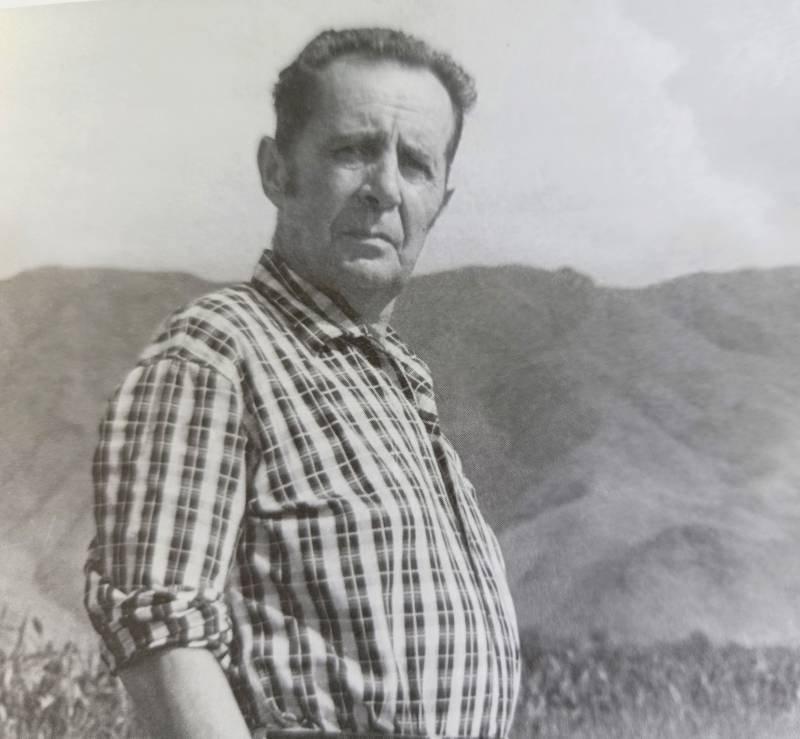
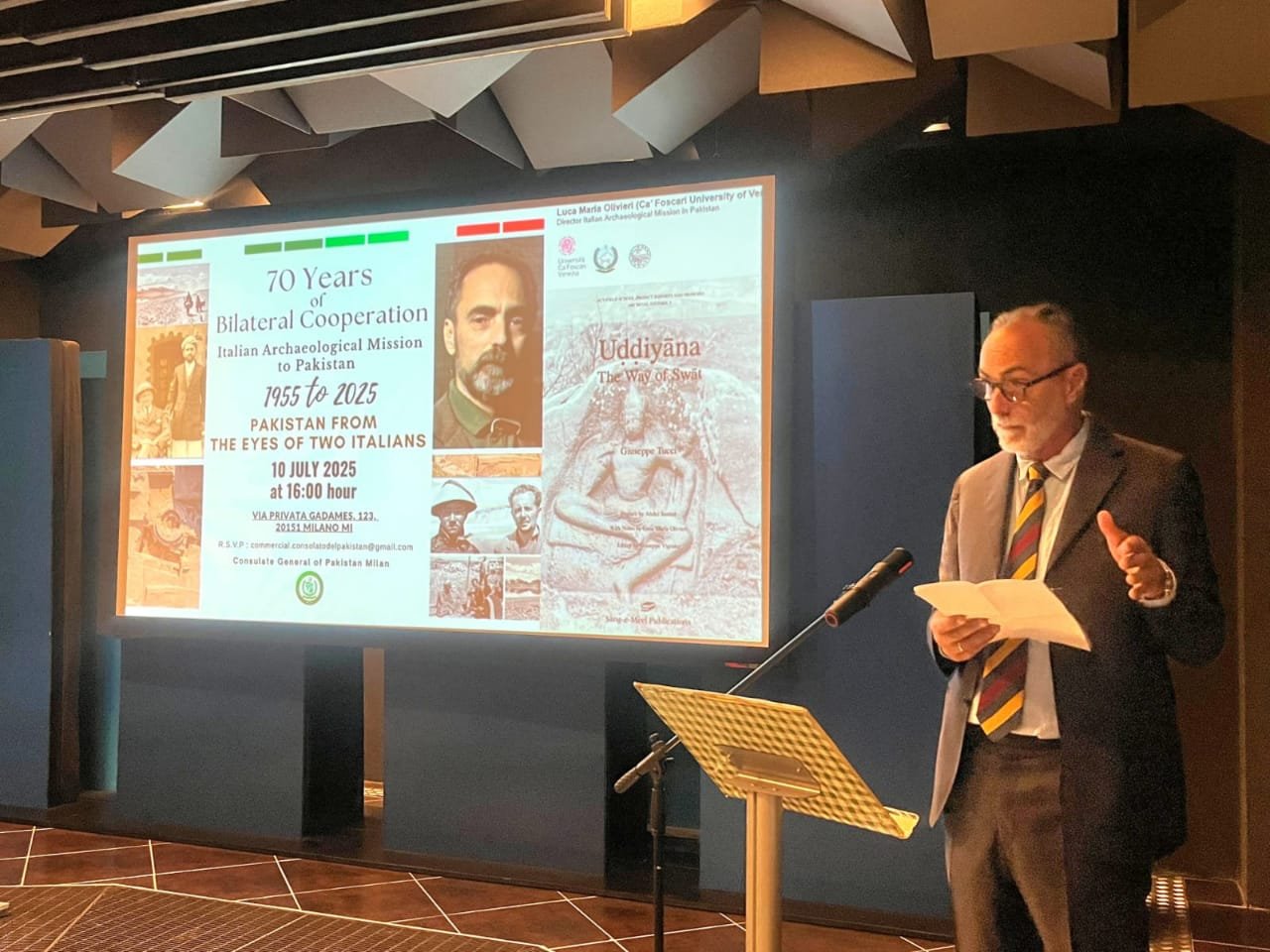
Although Pakistan and Italy established formal diplomatic relations soon after 1948, the relationship acquired its first durable foundation through an unconventional channel: state‑supported civilizational diplomacy. In November 1955, Professor Giuseppe Tucci, founder of the Istituto Italiano per il Medio ed Estremo Oriente (IsMEO) and one of Europe’s most influential Orientalists, launched the Italian Archaeological Mission in the Swat Valley.3
Backed by the Italian Ministry of Foreign Affairs and drawing on considerable diplomatic goodwill in both Rome and Islamabad, Tucci secured exclusive excavation rights from Pakistan’s federal and local authorities.4 For a newly postcolonial state seeking to assert cultural sovereignty, granting such access to a European mission was an extraordinary concession.
Tucci framed Gandhara as a “crocevia di civiltà” (meeting place of civilizations), a description that shaped IsMEO’s scientific and diplomatic posture in Swat.5 Over the next two decades, IsMEO (later IsIAO) transformed the valley into Italy’s most significant archaeological base outside Europe.
Continuous excavations at Butkara I, Udegram, and Barikot introduced advanced Restauro (restoration) and conservation methodologies to Pakistan’s heritage institutions, engineering faculties, and university departments.6 Italian MFA reports from the period described the mission as a “pilastro della presenza culturale italiana in Asia” (pillar of Italy’s cultural presence in Asia), highlighting its strategic value.7
Through joint publications, shared fieldwork, and collaborative museology frameworks, Italian and Pakistani scholars built a dense intellectual network that operated with remarkable continuity despite regional turbulence. Pakistan’s Department of Archaeology later credited the mission with the systemic introduction of modern conservation practices to national institutions,8 while UNESCO assessments reinforced Gandhara’s status as a heritage of outstanding universal value.9
Training programs, conservation workshops, and co‑authored monographs strengthened Pakistan’s academic infrastructure, fostering deep institutional links with departments at Peshawar University and the National Museum.
In effect, the Swat–Rome axis became a civilizational partnership; a long‑running corridor of cooperation that generated institutional goodwill, elevated both nations’ cultural visibility in international forums, and established a stable Italian presence in Pakistan well before commercial or security‑driven diplomacy matured.
Trieste–Lahore and the Rise of Scientific Diplomacy (1964–1990s)
The most consequential pillar of Pakistan–Italy intellectual cooperation emerged through science. In the early 1960s, Dr. Abdus Salam, Pakistan’s Nobel‑winning physicist, and Italian physicist Paolo Budinich envisioned a new model of scientific mobility grounded in the belief that “scientific thought is the common heritage of mankind.”10
They proposed creating a centre where researchers from developing countries could access advanced scientific environments without permanently leaving their home institutions. With support from the Italian government, the International Centre for Theoretical Physics (ICTP) was established in Trieste in 1964.11 Although located in Italy, ICTP was built around Salam’s framework of structured scientific mobility, enabling Pakistani physicists to engage with leading research communities, develop international networks, and return home to strengthen their own universities and laboratories.
Trieste quickly became a scientific lifeline for Pakistan. Figures such as Faheem Hussain, Asghar Qadir, and Riazuddin became regular ICTP participants, using Trieste’s seminars, workshops, and collaborative research networks to deepen their expertise before returning to Pakistan to build departments, modernize curricula, and cultivate the country’s emerging theoretical physics community. This circulation of talent offered Pakistan a rare alternative to the one‑way migration patterns that dominated scientific careers in the developing world, allowing it to strengthen national institutions without losing its brightest minds.12
The ecosystem expanded systematically through the Training and Research in Italian Laboratories (TRIL) program in 1983 and the establishment of the Third World Academy of Sciences (TWAS) in 1988, both heavily supported by Italy’s Ministry of Foreign Affairs. By embedding Pakistani post‑doctoral fellows directly into premier Italian state laboratories, the Trieste–Lahore axis cultivated a resilient, self‑sustaining epistemic community that remained insulated from the shifting political currents of the Cold War. These networks produced long‑term collaborations, joint publications, and institutional linkages that reinforced Pakistan’s scientific infrastructure while positioning Italy as a credible advocate for equitable knowledge exchange.13
As ICTP and TWAS expanded, the Trieste–Lahore axis elevated both countries within the emerging landscape of global science diplomacy. The networks built through fellowships, joint research, and long‑term collaborations strengthened Pakistan’s scientific infrastructure while reinforcing Italy’s reputation as a committed partner in fair and reciprocal scientific collaboration. The scientific institutions anchored in Trieste became a durable diplomatic bridge, advancing Pakistan–Italy relations through intellectual cooperation at moments when formal political channels were limited.14
Structural Strain and Geopolitical Realignment (1975–1999)
By the mid‑1970s, Pakistan–Italy academic diplomacy stood at a potentially transformative juncture. Two decades of intellectual cooperation had created an unusually resilient corridor between the two countries. Both governments now sought to convert this momentum into a formal, state‑level framework. The 1975 Bilateral Cultural Agreement was designed to institutionalize reciprocal degree recognition, establish postgraduate scholarship quotas, and shift academic mobility from ad‑hoc channels to a structured diplomatic instrument.15
The agreement, however, failed to materialize. Italy’s centralized university bureaucracy struggled to evaluate credentials produced by Pakistan’s British-legacy annual examination system, while Pakistan lacked the administrative capacity to implement new mobility frameworks. This created a historical mismatch where bilateral goodwill met domestic administrative structures that were fundamentally unable to communicate. Consequently, the agreement remained dormant not for lack of diplomatic interest, but because neither side possessed the institutional agility required to bring its provisions into effect.16
A second rupture emerged in 1990, when Italy implemented the Martelli Law17 and entered the borderless Schengen Area. These European protocols required Rome to adopt strict external border controls, subordinating bilateral academic goodwill to continental migration and security priorities.18 Pathways previously used by Pakistani researchers such as short‑term scientific visas, cultural research permits, and ICTP‑linked mobility channels were replaced by rigid quota‑based procedures. Italy’s shift from national discretion to EU‑wide regulation introduced an administrative barrier that Pakistan’s academic sector could not easily navigate.
The post‑Cold War decade introduced a different kind of diversion. Pakistan and Italy coordinated closely within the “Coffee Club,”19 later the Uniting for Consensus movement, to oppose unilateral expansions of permanent seats on the United Nations Security Council. While this alignment strengthened multilateral cooperation, it simultaneously absorbed diplomatic bandwidth that had previously supported bilateral scientific structures. Intellectual collaboration did not disappear, but it lost the institutional attention required to sustain the momentum built during the Trieste–Lahore years.
The final shock of the decade emerged from the tightening global non-proliferation architecture. Following regional nuclear developments in South Asia in the late 1990s, the international community responded with sweeping multilateral restrictions.20 Concurrently, the evolution of multilateral export control regimes, which increasingly scrutinized intangible technology transfers (ITT), placed unprecedented administrative burdens on sensitive academic collaborations.21 What had once been a highly flexible, open scientific corridor now had to navigate a dense web of international vetting procedures, signaling an end to the era of friction-free academic mobility.
Across the closing two decades of the twentieth century, administrative mismatches, evolving European migration reforms, multilateral diplomatic diversions, and international non‑proliferation sanctions produced a cumulative attrition within this bilateral corridor. The Pakistan–Italy intellectual axis did not decline because its inherent value diminished; rather, its operational capacity was systematically constrained by the tightening architecture of supranational security and migration regimes.
The Structural Logic of Durable Cooperation
The history of Pakistan–Italy relations from 1948 to 1999 shows that their most durable cooperation grew out of structured intellectual exchange rather than conventional diplomacy. Archaeological work in Swat and scientific mobility in Trieste were not peripheral episodes; they formed the architecture that sustained the relationship through decades of geopolitical turbulence. These channels endured because they were built to operate beyond the volatility of political cycles, grounded in autonomous institutions, shared epistemic norms, and long‑term professional networks.
Periods of weakened cooperation reveal the same structural truth. Academic exchange proved vulnerable whenever it relied on improvised administrative pathways or was treated as a secondary diplomatic concern. In the end, systems, not intentions, determined resilience. The collapse of loosely governed channels, whether through bureaucratic mismatches, migration reforms, or non‑proliferation regimes, reflected failures of design rather than failures of goodwill.
Taken together, this historical arc clarifies how states build partnerships that endure. Pakistan and Italy sustained their relationship through knowledge communities capable of outlasting the shocks that reshaped the international system. Their experience shows that the most durable diplomacy emerges from intellectual cooperation that is professionally governed, institutionally protected, and insulated from the volatility of political cycles. In these structured spaces, where ideas rather than alliances carry the weight of engagement, long‑term stability is most reliably secured.
Dionysios Chourchoulis, The Southern Flank of NATO, 1951–1959: Military Strategy or Political Stabilization? (Lanham, MD: Lexington Books, 2014), 11–13; see also Mariele Merlati and Daniela Vignati, “Risk and Opportunity: Italy in the Troubled Mediterranean during the 1970s,” Athens Journal of Mediterranean Studies 9, no. 3 (2023): 164–166, https://doi.org/10.30958/ajms.9-3-2. [↩]
Giuseppe Tucci, La via dello Swat (1963), repr. in Swāt Archaeology – From Tucci to the Present, ed. Luca Maria Olivieri (Venice: Edizioni Ca’ Foscari, 2024), 12–15, https://iris.unive.it/handle/10278/5068182. [↩]
Luca Maria Olivieri, “Archaeology in Swat,” Ancient Pakistan 20 (2009): 135–144; Massimo Vidale, Roberto Micheli, and Luca Maria Olivieri, eds., Excavations and Conservation Activities in Swat District (2011-2013) Khyber-Pakhtunkhwa – Pakistan, vol. IV, Excavations at the Protohistoric Graveyards of Gogdara and Udegram (Rome: ISMEO; Venice: Edizioni Ca’ Foscari, 2022). [↩]
Ministero degli Affari Esteri e della Cooperazione Internazionale (MAECI), Le Missioni Archeologiche Italiane: Uno strumento di diplomazia culturale nel mondo (Rome: Direzione Generale per la Promozione del Sistema Paese, Ufficio VI, 2016). [↩]
Pakistan-Italian Debt Swap Program (PIDSA), Archaeology, Community, Tourism – Field School (ACT): A Joint Project of the Italian Archaeological Mission and the Directorate of Archaeology and Museums, Khyber Pakhtunkhwa Province (Peshawar: DOAM; Rome: ISMEO, 2014), 14–18. [↩]
UNESCO World Heritage Centre, “Buddhist Ruins of Takht-i-Bahi and Neighbouring City Remains at Sahr-i-Bahlol: Advisory Body Evaluation (ICOMOS),” (Paris: UNESCO World Heritage Centre, 1980), 1–3, https://whc.unesco.org/en/list/140/documents/. [↩]
Abdus Salam, Ideals and Realities: Selected Essays of Abdus Salam, ed. C. H. Lai, 2nd ed. (Singapore: World Scientific Publishing, 1987), 14–18. [↩]
International Centre for Theoretical Physics, From a Vision to a System: The International Centre for Theoretical Physics of Trieste (1964–1994), ed. A. M. Hamende (Trieste: Fondazione Internazionale Trieste per il Progresso e la Libertà delle Scienze, 1995), 12–25. [↩]
International Centre for Theoretical Physics, Tribute to Abdus Salam: Commemoration Day, 21 November 1997, ed. A. M. Hamende (Trieste: ICTP Publications, 1999), 5–14. [↩]
International Centre for Theoretical Physics, One Hundred Reasons for Science: ICTP 40th Anniversary (Trieste: ICTP Publications, 2004), 12–18. [↩]
Riazuddin, “Scientific Cooperation in Theoretical Physics,” in Islamic Scientific Thought and Muslim Achievements in Science: Papers Presented, International Conference on Science in Islamic Polity, vol. 2 (Islamabad: Ministry of Science and Technology, 1983), 45–52. [↩]
Cultural Agreement between the Government of the Republic of Italy and the Government of the Islamic Republic of Pakistan (signed March 17, 1975, entered into force November 24, 1976), United Nations Treaty Series 1044, No. I-15745. For domestic ratification: Legge 11 ottobre 1976, n. 811, Gazzetta Ufficiale della Repubblica Italiana, no. 327 (December 9, 1976). [↩]
G. Capano, “Looking for Serendipity: The Problematical Reform of Government within Italy’s Universities,” Higher Education 55, no. 4 (2008): pp. 481–504. For Pakistan: Shams Kassim-Lakha, “The State of Higher Education in Pakistan,” The International Journal of Educational Management 14, no. 5 (2000): pp. 191–197. [↩]
Legge 28 febbraio 1990, n. 39, “Conversione in legge, con modificazioni, del decreto-legge 30 dicembre 1989, n. 416, recante norme urgenti in materia di asilo politico, di ingresso e soggiorno dei cittadini extracomunitari e di regolarizzazione dei cittadini extracomunitari ed apolidi già presenti nel territorio dello Stato. Disposizioni in materia di asilo,” Gazzetta Ufficiale della Repubblica Italiana, n. 49, February 28, 1990, https://www.gazzettaufficiale.it/eli/id/1990/02/28/090G0073/sg. [↩]
“Agreement on the Accession of the Italian Republic to the Convention Implementing the Schengen Agreement of 14 June 1985,” (November 27, 1990), Official Journal of the European Communities L 239 (September 22, 2000): pp. 63–68, [https://eur-lex.europa.eu/legal-content/EN/TXT/?uri=CELEX:42000A0922(03](https://eur-lex.europa.eu/legal-content/EN/TXT/?uri=CELEX:42000A0922(03). [↩]
Nico Schrijver, “Reforming the UN Security Council in Pursuance of Collective Security,” Journal of Conflict & Security Law 12, no. 1 (2007): 127–138, https://doi.org/10.1093/jcsl/krm003. [↩]
Council Decision 97/633/CFSP of 22 September 1997 amending Decision 94/942/CFSP on the joint action adopted by the Council on the basis of Article J.3 of the Treaty on European Union concerning the control of exports of dual-use goods, Official Journal of the European Communities L 266 (September 29, 1997): 1–214, https://eur-lex.europa.eu/legal-content/EN/TXT/?uri=CELEX:31997D0633 [↩]