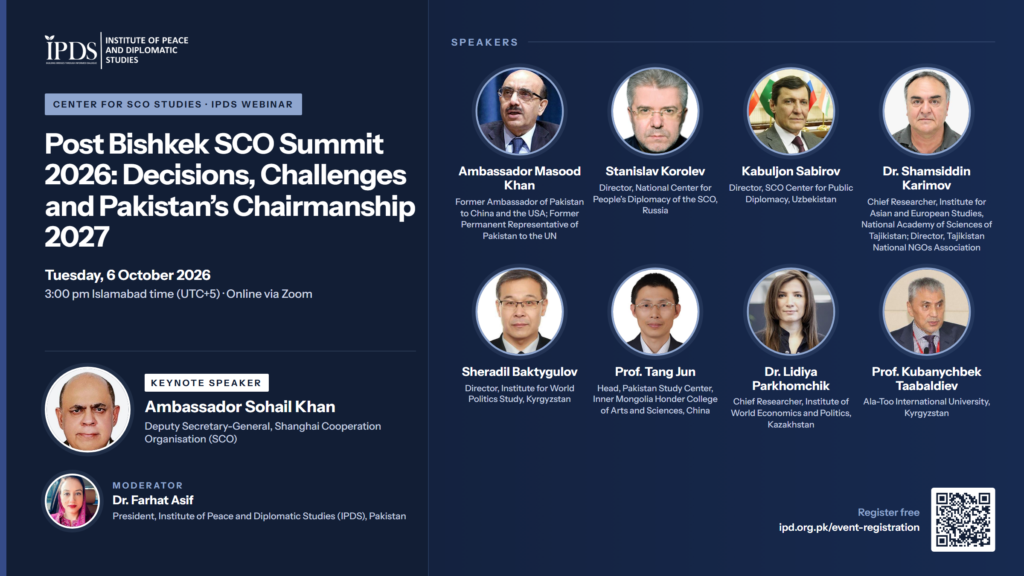
The Center for SCO Studies at the Institute of Peace and Diplomatic Studies (IPDS) hosted an online webinar on 6 October 2026 reviewing the outcomes of the 26th SCO Summit in Bishkek and the priorities ahead of Pakistan’s chairmanship of the Organisation in 2027. The panel brought together diplomats, policy experts and scholars from Pakistan, Russia, Uzbekistan, Tajikistan, Kyrgyzstan, China and Kazakhstan.
Opening the session, Dr. Farhat Asif, President of IPDS, recalled Pakistan’s early years as an SCO member and described how the Center for SCO Studies has built its SCO Observatory and the SCO Commitments Tracker as reference resources for researchers.
In the keynote address, Ambassador Sohail Khan, Deputy Secretary-General of the SCO, reviewed the outcomes of the summit and outlined the areas Pakistan’s chairmanship is expected to focus on: information technology and artificial intelligence, energy, poverty reduction and development, humanitarian cooperation, and regional cooperation.
Highlights from the panel
- Prof. Kubanychbek Taabaldiev (Kyrgyzstan): the task for Pakistan is turning political consensus into institutional implementation; he also spoke on Central Asia’s multi-vector diplomacy.
- Stanislav Korolev (Russia): welcomed the plan for the development of ports and logistics for 2026–2030 confirmed at Bishkek, and noted that a single SCO development bank and an independent payment system remain unresolved.
- Prof. Tang Jun (China): Pakistan is likely to advance digital governance mechanisms, and its chairmanship will be judged by concrete next steps on initiatives already under way.
- Sheradil Baktygulov (Kyrgyzstan): described the Bishkek Declaration as one of the most significant documents in the SCO’s history.
- Dr. Shamsiddin Karimov (Tajikistan): called for a broader view of security under Pakistan’s chairmanship, one that prioritises investment in human capital.
- Dr. Lidiya Parkhomchik (Kazakhstan): stressed the need for investment synergy, noting that economic integration among members is still a work in progress.
- Kabuljon Sabirov (Uzbekistan): pointed to the World Nomad Games, held alongside the summit, as an example of how heritage, sport and people-to-people contacts complement diplomacy.
- Ambassador Masood Khan (Pakistan): said the 2027 summit will highlight the role of multipolar diplomacy in integrating Eurasia, with Pakistan established as a trusted diplomatic hub.
The webinar continues IPDS’s tradition of post-summit dialogues on the SCO.
Read more