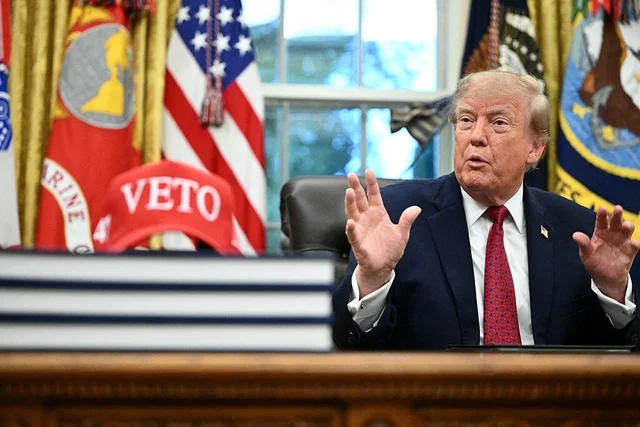
In Trump’s final two years, the 2026 midterms will not make him a weaker president so much as a different kind of president. With Democrats taking both chambers on January 3, 2027, the administration loses its main legislative route of party-line budget reconciliation. It keeps the veto, a large toolkit of executive authority and enforcement money already locked in through 2029. History favors the veto, as Congress has overridden only 112 of 2,599 presidential vetoes since 1789. The likely result is a presidency that governs around Congress rather than through it, although scholars find that divided government does not reliably raise the number of executive orders, so the change lies more in the choice of tools than in a surge of orders.
This shift matters because executive power is faster but less durable than legislation. It is also more exposed to courts and to statutory limits that Congress itself wrote. The Supreme Court’s February 2026 ruling against the emergency-powers tariffs showed both how far the administration will push executive authority and where that authority stops.
The central forecast of this brief is managed gridlock: Democratic bills, presidential vetoes, intensive oversight, and recurring funding confrontations. Two other paths are possible: (i) selective bargains or (ii) institutional crisis. The brief identifies the signs that would show which path is unfolding. For anyone dealing with Washington, the practical lesson is to expect more unilateral action, shorter policy horizons, and less predictability until January 2029.
Why Was This Midterm Election Different?
Historically, losing seats at midterm is normal for a president’s party. Since 1946, the president’s party has lost House seats in 18 of the 20 midterms. What sets 2026 apart is the scale of the loss in both chambers at once.
| Midterm |
President |
House seat change |
Senate seat change |
Chamber lost |
| 1986 |
Reagan (2nd term) |
-4 to -5 |
-8 |
Senate |
| 2006 |
G.W. Bush (2nd term) |
-30 |
-6 |
Both |
| 2014 |
Obama (2nd term) |
-13 |
-9 |
Senate |
| 2018 |
Trump (1st term) |
-42 |
+1 |
House |
| 2026 |
Trump (2nd term) |
About -41 to -42 (provisional) |
-7 |
Both |
Sources: 2006, 2014 and 2018 from Brookings Vital Statistics. For 1986, Al-Jazeera reports a four-seat House loss and an eight-seat Senate loss; Politics PA reports five. For 2026, House figures are net Democratic gains of 41 seats reported by NBC News and 42 reported by Fox News, with races still uncalled; the Senate figure is the seven flipped seats reported by NBC News.
Three features of this midterm make its results a structural break rather than a routine correction.
- Its scale: The House loss is larger than any recent second-term midterm in the table. It roughly matches the 37-seat average loss Gallup found for presidents below 50% approval. Early exit polls put Trump’s 2026 approval at 38%.
- Its breadth: Democrats led the national House vote by 12.8 points with over 113 million votes counted. They also flipped Senate seats in Texas, Kansas, and South Carolina.
- Its timing: Trump is barred from a third term by the Twenty-Second Amendment. He therefore faces a hostile Congress for his entire remaining term, with no incentive to moderate to win re-election.
As of November 11, 2026, Democrats had won 255 House seats, with 16 races still uncalled, and held at least 54 Senate seats, including two independents who caucus with them. Alaska and Mississippi were uncalled. Final figures may differ.
Read More: The United States and the Global Political Outlook in the Aftermath of the 2026 US Midterm Elections
What Dies, What Survives: The Legislative Agenda
The administration’s legislative model has been party-line reconciliation, and that model ends in January. Most Republican laws in this Congress passed through two reconciliation bills, which need only a simple Senate majority. Without control of both chambers, the administration cannot use that route again.
What dies: Any new party-line package, and any expansion of the agenda that needs Congress. CBS News described the result as effectively halting the president’s legislative agenda for his last two years.
What survives: Laws already enacted and multi-year money already appropriated would not be affected by these results. Immigration enforcement is the clearest example. A June 2026 law gave Immigration and Customs Enforcement (ICE), Customs and Border Protection, and the Department of Homeland Security (DHS) nearly $70 billion, available through 30 September 2029. NPR reports that ICE and DHS have enough money to continue mass deportation operations for the rest of the term. Front-loaded funding of this kind blunts Congress’s power of the purse.
What becomes contested: Democrats plan early bills to restore Affordable Care Act subsidies, reverse Medicaid cuts, rescind tariffs, and require the president to end the Iran war or obtain authorization. These bills can pass but cannot become law without the president’s signature. A veto override requires two-thirds of each chamber. On the November 11 counts, Democrats would need 13 Republican senators (67-54) and about 35 Republican House members (290-255, if all 435 members vote). These are the author’s calculations from the counts above, assuming every Democrat and independent votes to override.
What might be bargained: A narrow overlap exists between must-pass and bipartisan items. Before the election, the agenda already included an energy permitting deal, and this Congress passed a bipartisan housing bill.
The Lame-Duck Window
The administration’s last chance for unified-government action runs from November 9 to Christmas, with some heavy agenda items including:
- Government funding before the stopgap expires on December 11;
- The defense authorization and farm bills;
- Possibly a third reconciliation package to fund the Iran war and election security grants;
- Pending judicial nominations.
Democrats have had little reason to cooperate, knowing they take control in January. Defeated Republicans may also resist another party-line bill. A full-year spending deal is considered unlikely, so another stopgap is the probable outcome.
The Administration’s Strongest Weapon: The Veto
The veto will become the president’s main tool from January 2027, and history shows that it almost always holds. Since 1789, only 112 of 2,599, or 4.3%, of presidential vetoes have been overridden by Congress. Counting only the 1,533 regular vetoes that Congress had a chance to override, the rate is 7.3%.
Source for veto counts: US Senate, Vetoes, 1789 to Present
Scholars treat the veto as both a bargaining tool and a final act. Cameron’s study of divided government shows how presidents use veto threats and vetoes to win concessions from a hostile Congress. Groseclose and McCarty add that, because voters are watching, Congress may write bills it expects to be vetoed in order to shape opinion of the president.
Four lessons follow for 2027-2028.
a) Vetoes surge after a midterm defeat. Every recent president who lost Congress turned to the veto, as the table shows. The threat matters as much as the act. In 2007, the White House said Bush had issued 39 veto threats since Democrats took over that January.
b) Overrides happen only when the president’s own party breaks. Obama’s single override was a bill letting 9/11 families sue Saudi Arabia, which passed 97-1 and 348-77. Trump’s single first-term override was the annual defense bill. Bush’s first was a $23 billion water resources bill. All three were broadly popular bipartisan measures, not partisan flagship bills.
c) On war funding, the veto has beaten Congress before. In May 2007, Bush vetoed an Iraq war funding bill that set a troop withdrawal timetable. The House override failed 222-203, and leaders began work on a new bill. Democrats later prepared major concessions on war funding because they could not overcome his vetoes. This is the closest precedent for a Democratic attempt to defund the Iran war.
d) Trump has already used the veto to protect executive power. Trump’s first-term vetoes blocked two resolutions ending his border emergency declaration, a Yemen war powers resolution and an Iran war powers resolution. Congress sustained all four. These are the same kinds of authority he will rely on now.
Assessment
The veto will hold on partisan bills such as health subsidies. It is most at risk when Republicans share Democratic objections, above all on tariffs. One warning sign arises here for Democrats: in January 2026, the House sustained vetoes of two bills that both chambers had passed by unanimous voice vote. Whether that party discipline survives a defeat of this scale is the key unknown.
Read More: A Democratic Congress and Pakistan: Navigating a Divided Washington
Governance: The Shift to Executive Power
The Trump administration is already the most prolific user of executive orders in decades, and the midterms raise the incentive to rely on them. Trump issued 292 executive orders in his second term by the end of October 2026. His average of 168 per year is the highest of any president since 1981. With legislation closed off, executive action becomes the main way to advance policy.
The administration has prepared for this. A wire report in the News Tribune says that senior officials, including Stephen Miller and budget director Russell Vought, have worked with the White House Counsel’s Office since April to identify executive actions on immigration, tariffs, housing costs and federal spending that require no congressional approval, according to three anonymous sources. The same report notes that congressional investigations cannot be sidestepped this way.
The Limits of Governing Alone
Executive power is fast, but 2026 has shown where it stops. Under a Democratic Congress, three constraints will tighten.
a) Statutory limits. On February 20, 2026, the Supreme Court ruled 6-3 that the International Emergency Economic Powers Act (IEEPA) does not authorize tariffs. The administration replaced them with a surcharge under Section 122 of the Trade Act of 1974, which is capped at 150 days unless Congress extends it. Congress did not extend it, and it expired on July 24, 2026. Later, the administration turned to other trade statutes. The lesson is that the executive can find workarounds, but each one runs on authority Congress delegated and can narrow.
b) Oversight. From January 2027, Democrats are set to gain subpoena power over the administration. The incoming oversight chair plans to examine Trump family business interests, including cryptocurrency ventures, and immigration enforcement. After the 2018 midterms, the first Trump administration refused to send officials to testify, withheld documents and ignored subpoenas. A repeat would push disputes into the courts and slow accountability. Pressure is already building: articles of impeachment against Defense Secretary Pete Hegseth were introduced within days of the election.
c) Personnel. On January 3, 2027, the Democrats will take over the Senate’s confirmation power. Trump’s Senate confirmed 56 to 57 judges in his second term, depending on the count. After the power shift, confirmations are expected to slow to a trickle. The same applies to cabinet and agency vacancies, which may push the administration toward acting officials.
The Administration’s Confrontation Signals
The White House response signals confrontation. On November 6, 2026, Stephen Miller, architect of the immigration crackdowns, was named by Trump as chief of staff, replacing Susie Wiles. A former senior Pence aide told Reuters that Miller is willing to fight Congress over immigration and investigations. Trump has also threatened to veto anything outside his agenda.
Assessment
The courts now become the main arbiter between a president governing by executive action and a Congress governing by oversight. This creates legal uncertainty for anyone affected by US policy, as litigation can reverse or delay major decisions.
Policy Priorities under Pressure
Four priorities will define the contest between the White House and Congress. In each, Congress holds a real tool; however, the administration keeps a way to resist.
Why is funding the decisive arena?
Congress holds the greatest power in appropriations, and the administration cannot simply veto its way out. Since every funding bill requires a signature, meeting each deadline forces a negotiation. In 2025, the shutdown lasted 43 days, the longest in US history, showing both sides’ willingness to accept long shutdowns.
Assessment
Congress will slow and narrow the administration’s priorities; still, it cannot easily reverse them. Policies built on independent executive authority or multi-year funding, for instance, immigration enforcement, are the most resilient. Policies that depend on annual funding or delegated statutes, such as tariffs and the Iran war, are the most exposed.
Three Scenarios to 2028
The next two years could unfold three ways. The likelihood ratings below are the author’s judgment, based on the evidence in this brief.
| Scenario |
What it looks like |
Signs to watch |
Likelihood |
| Managed Gridlock |
Democratic bills meet vetoes; oversight is intense but contained; stopgap funding bills keep the government open |
Short stopgaps rather than full-year deals; subpoena disputes settled in court; no successful veto override |
Most likely |
| Selective Bargains |
Narrow deals on trade, energy permitting or housing, driven by economic pressure or the 2028 race |
A bipartisan permitting or trade bill signed; a Republican bloc voting with Democrats on tariffs; a negotiated end to the Iran war |
Possible |
| Institutional Crisis |
Open defiance of subpoenas or court orders, long shutdowns, impeachment proceedings or disputes over election legitimacy |
Officials refusing to appear after court rulings; a shutdown longer than 2025’s 43 days; the president rejecting election results |
Less likely, but high impact |
Why Managed Gridlock Is the Baseline
The structure of power favors stalemate. Democrats can block nominees, pass bills and investigate, but they cannot override vetoes on their own. The president can veto and act alone, but cannot pass new laws or win confirmations. Neither side can impose its preferred outcome, so the default is a standoff.
Policy Implications
For the administration
The rational strategy is to consolidate gains rather than expand. In practice, that means three things:
- Using the lame-duck session for funding, judicial confirmations and defense;
- Choosing executive actions that rest on clear statutory authority;
- Protecting multi-year programs already funded.
The tariff ruling of February 2026 shows that actions on weak legal grounds can be struck down, along with the policy built on them. The trade-off is speed: actions grounded in clear statutory authority are slower and narrower, but less likely to be reversed in court.
For Congress
The strongest lever for Democrats is appropriations, not standalone bills inviting vetoes. Their main risk is overreach. If oversight looks like retribution, it could undercut the affordability message that won them the election. NPR has raised exactly this question.
Conclusion
The 2026 midterms ended the administration’s ability to govern through Congress, but not its ability to govern. In Trump’s final two years, power will flow through multi-year funding already secured, executive orders, vetoes, and battles in court. Congress will answer with subpoenas, appropriations and confirmations.
The most likely outcome is managed gridlock. The most important variable is whether the administration treats the results, and the Congress they produced, as legitimate. For the rest of the world, the message is clear: a confrontational presidency is fast-moving but less durable, and US commitments made by one person can be undone by the institutions he governs around.
Disclaimer: The views expressed in this article are solely those of the author and do not necessarily reflect the official policy, position, or stance of the Institute of Peace and Diplomatic Studies (IPDS).
Babar Ali
PHD Researcher at the University of Salerno, Italy. He can be reached at: bali@unisa.it