The dawn of the twenty-first century forced a profound paradigm shift upon higher education governance worldwide; internationalisation shifted from symbolic prestige to structural necessity. For Pakistan and Italy alike, the limitations of the legacy model of knowledge diplomacy, traditionally anchored in elite fellowships and informal epistemic networks, became increasingly evident during this period. A more formal, predictable, and scalable architecture for intellectual exchange was now required.
As both states entered a rapidly shifting global higher education landscape, their domestic reforms moved along sharply different administrative paths. Italy, as an early architect of the Bologna Process, became deeply embedded in building the European Higher Education Area (EHEA), reorganising its internal governance around the three-cycle degree structure, ECTS-based credit recognition, and cross‑border academic mobility.
Pakistan’s reform trajectory unfolded in a contrasting direction. With the establishment of the Higher Education Commission (HEC), the country prioritised centralised accreditation, national assessment benchmarks, and quality assurance frameworks modelled more closely on Anglo‑American standards than on European harmonisation. This divergence placed Pakistan within a distinct governance orbit; one oriented toward domestic standardisation rather than inter-institutional mobility, limiting direct alignment with Italy’s increasingly Europeanised system.
These contrasting reforms produced a natural drift between the two systems and reshaped the bilateral corridor. Even as formal university registries faltered under bureaucratic weight, the underlying impulse of knowledge diplomacy did not decay; it adapted. Italy’s ratification of the Lisbon Recognition Convention embedded its higher education system within a multilateral framework for fair recognition of qualifications, reinforcing the Europeanised trajectory inaugurated by the Bologna Process. This legal architecture preserved Italy’s structural openness to external academic cooperation even as Pakistan consolidated a more domestically oriented, accreditation‑driven model under the Higher Education Commission.
Within this environment of partial compatibility and systemic divergence, Pakistan–Italy engagement sustained momentum by shifting into domains where technical expertise and field-based collaboration could override administrative misalignment. Climate research in the Karakoram, heritage revitalisation in Swat, and industrial upgrading in Islamabad each functioned as adaptive vectors that kept the corridor active despite the absence of harmonised degree structures or aligned mobility frameworks. By combining Italy’s recognition instruments with these specialised, problem-driven partnerships, the corridor persisted and evolved, ultimately converging into a new era of more deliberate academic alignment.
Karakoram-Lombardy and the Emergence of Climate Diplomacy (2000-2010)
While the emergence of formal climate diplomacy between Italy and Pakistan crystallized in the 2000-2010 decade, this period of engagement was supported by a long-standing tradition of high-altitude research, building upon the scientific legacy of the 1954 K2 expedition and the 1989 establishment of the Ev-K2-CNR association.
Environmental cooperation evolved during these years into one of the corridor’s most enduring avenues of engagement. Italian expertise in Alpine glaciology aligned naturally with Pakistan’s need to monitor climate impacts in the northern regions; this synergy was instrumental in developing the Central Karakoram National Park (CKNP), established in 1993, into a fully operational hub, empowering institutions such as Ev-K2-CNR and the subsequently founded Karakoram International University (KIU) to establish high‑altitude field stations during this formative era.
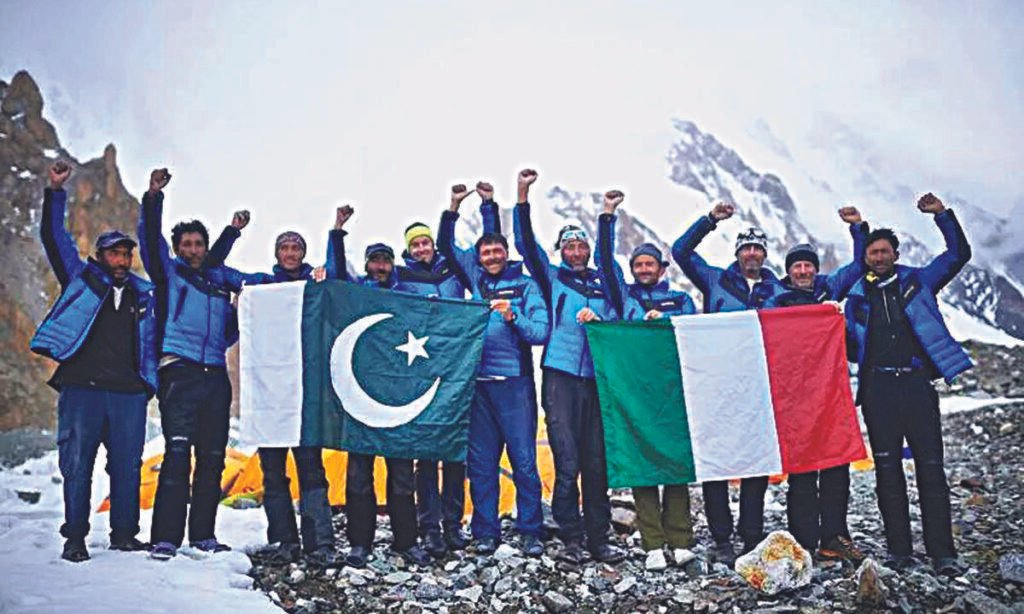
Supported academically by mountain‑science researchers at the University of Milan and guided by Italian mountaineer‑researcher Agostino Da Polenza, alongside CKNP director Dr Muhammad Iqbal, the Pakistan-Italy climate partnership achieved a landmark: the installation of the world’s highest meteorological station on K2 in 2004.
This flagship achievement transferred advanced satellite‑mapping techniques, automated weather‑monitoring systems, and climate-risk assessment tools to Pakistani researchers, keeping scientific networks active on the glaciers even when access to laboratories was limited.
By anchoring Pakistan-Italy cooperation in global climate‑risk research, the corridor enabled both countries to participate in international mountain‑climate debates with empirical authority, strengthening their diplomatic profiles in scientific discussions linked to the United Nations Framework Convention on Climate Change (UNFCCC).
Swat and the Evolution of Heritage Diplomacy (2005–2017)
Development diplomacy opened a second adaptive pathway through the Pakistan-Italy Debt Swap Agreement (PIDSA) in 2006. This agreement redirected bilateral debt repayments toward locally managed development projects to expand knowledge exchange between the two countries, thereby repositioning heritage preservation as a vehicle for collaborative learning.
The Archaeology, Community, Tourism (ACT) initiative, implemented by the Italian Archaeological Mission (IAM) in partnership with the Directorate of Archaeology and Museums of Khyber Pakhtunkhwa, emerged as a cornerstone of the Pakistan–Italian Debt Swap Agreement (PIDSA). The initiative leveraged an academic backbone composed of Ca’ Foscari University of Venice and local partners to revitalize the Swat Valley’s heritage landscape.
Through modernized field schools, restoration training, and community-led museology programs, the ACT project strengthened Pakistan’s heritage institutions, expanded professional conservation pipelines, and re-established Swat as a leading centre for archaeological collaboration.
The Swat-Venice corridor reframed cultural diplomacy as a shared knowledge agenda. It strengthened Pakistan’s position within UNESCO-aligned heritage networks while reinforcing Italy’s reputation as a global leader in archaeological diplomacy, deepening bilateral trust through co‑produced training, research, and community-level outcomes.
Torino-Islamabad and the Rebuilding of Industrial Diplomacy (Post-2005)
A third vector of Pakistan-Italy engagement emerged through technical and industrial cooperation, where knowledge transfer functioned as a strategic diplomatic instrument. Central to this effort was the Joint UNIDO-SMEDA-Italy Programme, which brought together the United Nations Industrial Development Organization (UNIDO), Pakistan’s Small and Medium Enterprises Development Authority (SMEDA), and the Italian Investment and Technology Promotion Office (ITPO) in Rome. Drawing on technical expertise from Turin’s manufacturing and SME clusters, these entities worked together to channel Italian industrial know-how into Pakistan’s textile, marble, and leather sectors.
Complementing these institutional frameworks, the initiative utilised technical study tours and research-led knowledge exchange to bridge the gap between theoretical expertise and industrial application. By engaging Italian centres of applied knowledge, such as the ENEA Casaccia Research Centre (ENEA, “Development Cooperation,” ENEA International Activities, accessed July 15, 2026, https://www.enea.it/en/international-activities/international-relations/development-cooperation.html.)), the program provided Pakistani delegations with direct exposure to advanced technological solutions, including renewable energy applications and specialised manufacturing processes, tailored for the SME sector.
These interventions successfully implemented structured training modules, modern design technologies, and upgraded mechanical standards within Pakistani enterprises. By embedding these capacity-building efforts within UNIDO’s global industrial-modernisation frameworks, this period of technical cooperation demonstrated how specialised knowledge functions as a tool of diplomacy, positioning Pakistan and Italy as partners in inclusive industrial development and reinforcing their influence within multilateral economic-cooperation platforms.
Divergent Higher Education Systems and the Search for Alignment
Although Pakistan and Italy entered the twenty-first century with higher education systems on divergent trajectories, both governments recognised that sustaining their historical intellectual ties required a shift from legacy models to deliberate, renewed engagement. Rather than pursuing systemic harmonisation, both states invested in targeted academic bridges, project-specific partnerships, and technical capacity-building programmes that prioritised concrete scientific outcomes over administrative integration.
This strategy was inaugurated by the 2005 Agreement on Cultural, Scientific, and Technological Cooperation (Italy and Pakistan, “Agreement on Cultural, Scientific and Technological Cooperation,” signed October 25, 2005, Gazzetta Ufficiale della Repubblica Italiana no. 128 (June 4, 2007).)), which established a formal framework to revive bilateral academic connectivity. The subsequent 2006–2008 Executive Programme translated this diplomatic intent into operational pathways, selecting fields such as seismic engineering, applied mathematics, and technologies for cultural heritage, where collaboration relied on shared technical expertise rather than aligned degree structures.
Inter-university agreements served as the practical architecture for this engagement. On 20 September 2005, the University of Bologna and the COMSATS Institute of Information Technology formalised a Memorandum of Understanding (MoU) to establish a framework for bilateral cooperation, specifically aimed at offering joint degree programmes in mutually agreed disciplines. Simultaneously, Italian expertise in disaster prevention and engineering seismology was mobilised through targeted inter-institutional agreements. A key 2006 MoU between the Italian Ministry of Education, Universities and Research (MIUR) and the Higher Education Commission (HEC) of Pakistan facilitated cooperation in seismic risk mitigation, notably supporting the partnership between the European Centre for Training and Research in Earthquake Engineering (EUCENTRE) and the Earthquake Engineering Centre at the NWFP University of Engineering and Technology in Peshawar.
Further initiatives reinforced this logic: the University of Trieste, alongside the Friuli Venezia Giulia Region, Bahria University, and Azad Jammu and Kashmir University (AJKU), established a geomatics laboratory for hydrogeologic risk management, while the Politecnico di Torino’s involvement in the UESTP Karachi initiative bolstered Pakistan’s engineering education capacity.
Ultimately, these collaborations demonstrated that meaningful cooperation was possible even without structural alignment. By operating in the margins of their respective governance models, these initiatives reshaped the Pakistan-Italy academic corridor. However, this precision also defined their limits; while these bridges sustained collaboration, they could not fully reconcile the systemic distance between the two models, leaving the corridor to endure within boundaries set by architectures neither state could fully overcome.
The Structural Constraints of Knowledge Diplomacy
Despite sustained initiatives, academic collaboration remained constrained by the inherent divergence between the two national systems. Administrative mismatches regarding degree recognition and curriculum equivalence frequently hindered the conversion of project-based cooperation into sustainable, long-term academic mobility. This mismatch was amplified by the fact that Italy operated within the Lisbon Recognition Convention’s multilateral framework, while Pakistan remained outside these protocols, leaving qualification recognition asymmetrical despite otherwise productive cooperation. Italy’s integration into Europeanised accreditation protocols contrasted sharply with the HEC’s consolidation phase, creating systemic friction that often limited the ability of Pakistani institutions to scale technically complex collaborations or maintain momentum once initial project cycles concluded.
External policy frameworks further compounded internal administrative barriers. Migration and visa regimes added another layer of friction; Italy’s Schengen-aligned procedures, shaped by broader European security and mobility frameworks, made short-term academic access more bureaucratic than in earlier decades. Consequently, Pakistani researchers and students often faced lengthy processing times and rigid documentation requirements, limiting the ease with which academic exchanges could scale. While these constraints did not halt cooperation, they fundamentally defined the pace at which the corridor could grow.
Funding discontinuities further restricted the corridor’s trajectory, as many of the most successful collaborations remained anchored to time-bound development instruments or externally financed projects. When these cycles concluded, universities often struggled to maintain momentum due to the absence of sustained, long-term bilateral funding streams. A primary example is the Pakistan-Italy Debt Swap Agreement (PIDSA), which facilitated significant educational and scientific capacity-building projects; however, once the agreed debt-swap cycle reached its maturity, the institutional momentum for several linked academic initiatives waned, as there were no established mechanisms to transition these projects into permanent, self-sustaining bilateral programmes.
Furthermore, as Italian research resources increasingly migrated toward EU-wide frameworks, where Italy now maintains high participation rates, the space for discretionary, bilateral academic programmes narrowed. Pakistani institutions, meanwhile, faced ongoing structural challenges, including administrative fragmentation and limited financial autonomy, which hindered their ability to independently scale these initiatives.
These bottlenecks did not diminish the value of the collaborations; they clarified their structural boundaries. The corridor remained active, but it could not expand into a fully integrated academic ecosystem. Instead, it persisted through focused partnerships that operated effectively within their domains but could not overcome the systemic distance between the two higher education models. In this sense, the bottlenecks were not failures of intent but reflections of the governance architectures within which both states were working.
Adaptive Architecture in Pakistan-Italy Academic Continuity
Across the first two decades of the twenty-first century, Pakistan-Italy cooperation revealed a clear structural pattern: when higher education systems move along incompatible governance trajectories, knowledge diplomacy does not collapse; it reorganises itself. Climate research in the Karakoram, heritage revitalisation in Swat, and industrial upgrading in Islamabad each emerged as adaptive vectors that sustained collaboration even as academic registries, mobility frameworks, and accreditation systems struggled to align.
These initiatives show that the corridor’s durability has never depended on harmonised degree structures or administrative compatibility. It has relied on both countries’ ability to identify domains where technical expertise, field-based research, and problem‑driven cooperation override systemic differences. In these spaces, academic engagement remained functional and institutionally valuable despite the divergence of the Bologna‑aligned and HEC-driven models.
The constraints of the period, such as administrative mismatches, Schengen-linked mobility barriers, and discontinuous funding cycles, did not weaken the impulse for cooperation; they clarified its boundaries. The corridor persisted not as an integrated academic ecosystem but as a set of precisely targeted partnerships capable of operating across structural distance.
Across these decades, Pakistan and Italy continued to strengthen their knowledge diplomacy by adapting to systemic divergence rather than resisting it. Yet this very resilience also reveals an opportunity for the future. Although the two higher education systems evolved along different trajectories, they are not irreconcilable. With deliberate policy design and renewed bilateral commitment, strategic alignment is possible, enabling both states to move beyond adaptive cooperation toward a more structured, scalable, and forward‑looking academic partnership.