Beyond One Commodity: Structure and Sequence in the Pakistan–Rwanda Economic Relationship
Written by Muhammad Bilal
Abstract
Pakistan and Rwanda have, within the timeframe of five years, put in place the institutions through which a modern economic relationship is conducted. Pakistan opened its High Commission in Kigali in March 2021, under the Engage Africa policy. Rwanda’s first resident High Commissioner assumed charge in July 2024 and its High Commission in Islamabad was inaugurated in April 2025.
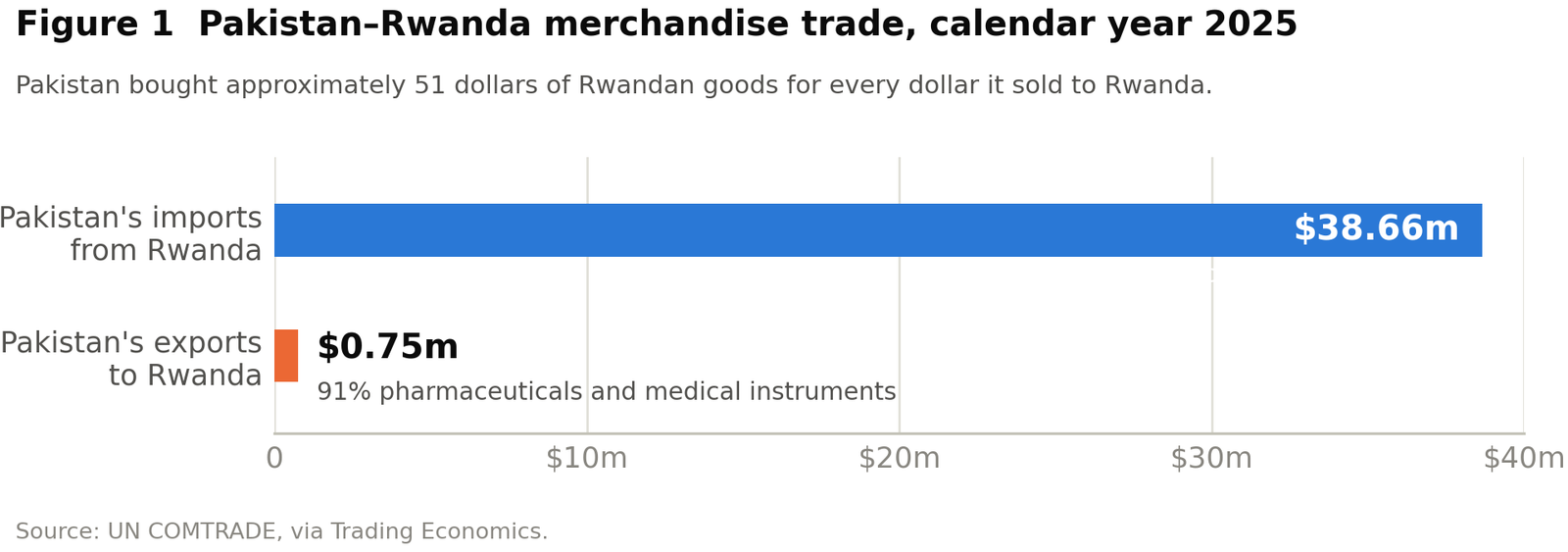
The trade instrument now before the two governments, and the Forum at which it is expected to be signed, complete a framework that was underway since 2021. Trade between them is at an early stage: in 2025 it stood at $38.66 million inbound and $750,780 outbound, concentrated in a single tariff chapter on one side and two product lines on the other. That composition reflects how recently the relationship acquired its institutions, not the scope it can reach.
What the two governments build on the new framework first, and in what order, will shape how quickly the base widens. Pharmaceuticals offer the earliest opening for Pakistani exports: seven Pakistani plants already hold good manufacturing practice listing with the Rwandan regulator, and product registration is the next step.
Rwanda offers most as a production base inside the East African Community, which is what its own investment rules are designed to reward. Non-commercial links deserve to be built alongside the commercial ones, since investment and institutional ties are the more durable sources of goodwill. Eight proposals follow, each naming the institution responsible on either side and an indicator that can be checked within twelve months.
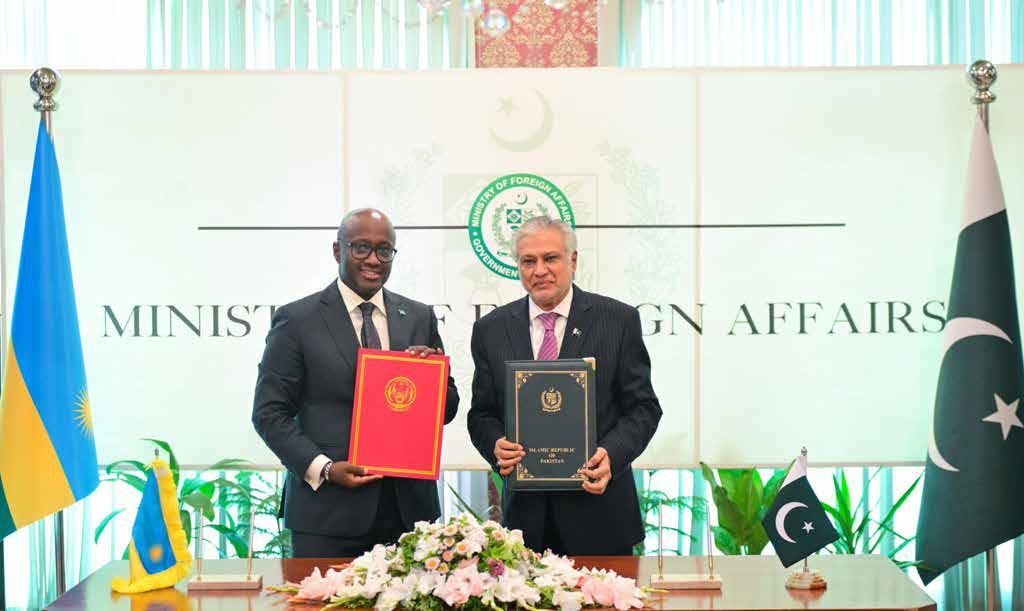
Officials and a Pakistani business delegation meet in Kigali from 23 to 25 September 2026 for the Rwanda–Pakistan Investment Forum. It meets at a point at which the institutional groundwork is in place: both countries have had resident High Commissions since April 2025. A bilateral trade instrument is expected to be signed there.
It took eight years in preparation. Pakistan shared the first draft in July 2018, and Pakistan’s federal cabinet approved the text in July 2026. The final form of the instrument and its signatories are yet to be announced. This paper states the position as at 22 September 2026.
The trade profile the two missions are working with is still taking shape, and its composition matters more than its size. Almost all of the inbound trade sits in a single tariff chapter, and two product lines make up more than nine-tenths of the outbound trade.
Both governments are now focused on widening the relationship beyond commerce. Peacekeeping is the most natural place to begin: both countries are among the world’s five largest contributors of peacekeepers, and a standing defence relationship between them is the obvious next step.
Research offers a second opening, with links between their universities and policy institutes still to be formed. Connectivity and media are the third, since a direct air link and regular coverage in each other’s press are both still to come. These are the areas with the most room to grow.
Fourth, a study of the Mombasa tea auction shows how much an established auction contributes, price discovery, quality grading and payment security — so a direct channel works best when it carries those functions with it, through published reference prices and an agreed grading basis.
3. The present position
3.1 Trade structure
Pakistan bought $38.66 million of Rwandan goods in 2025 and sold Rwanda $750,780. Of what Pakistan bought, $38.59 million falls under one chapter: coffee, tea, maté and spices. Of what Pakistan sold, pharmaceutical products accounted for $415,800 and optical, photographic and medical instruments for $265,100.
The Data is visualized through AI tools.
3.2 The commodity base
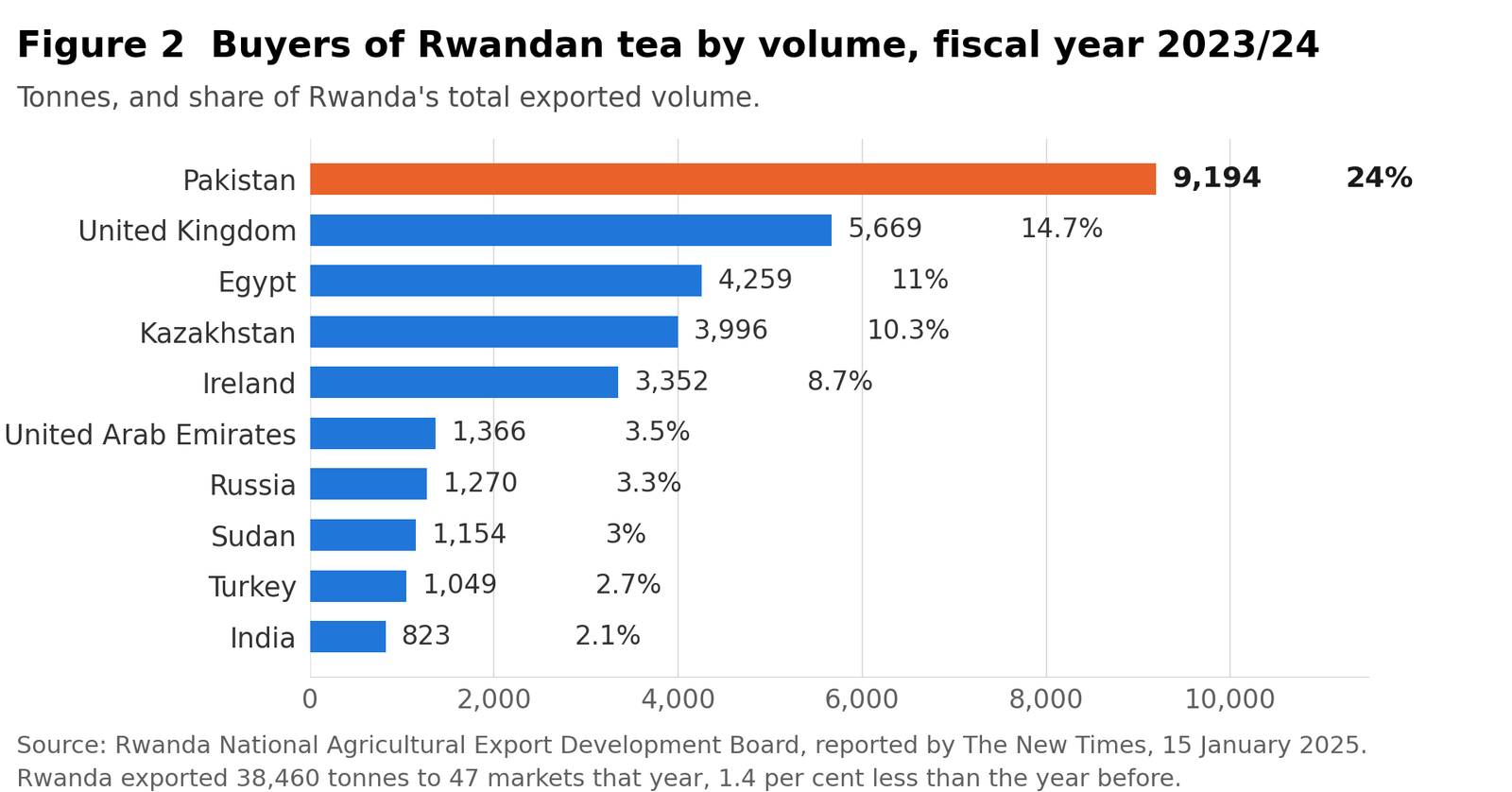
Tea accounts for most of the trade at present. It earned Rwanda $114.8 million in FY2023/24 on 38,460 tonnes sold into 47 markets. Pakistan took 9,194 tonnes of that, about 24 per cent, ahead of the United Kingdom, Egypt and Kazakhstan.
The Data is visualized through AI tools.
The open question is routing, not volume. In January 2025 the High Commissioner of Rwanda, Harerimana Fatou, put the Rwandan share of tea arriving in Pakistan at 45 per cent, routed through Kenya. The High Commissioner also named rice, cooking oil and pharmaceuticals as goods Rwanda imports in volume and would buy from Pakistan.
In June 2026 the Minister of Trade and Industry, Prudence Sebahizi, said that Rwandan tea is usually sold in Mombasa, “where groups of traders largely determine the price”, and that “we have now begun working with investors in Pakistan so that Rwandan tea can be sold directly there.”
Government figures put Rwandan tea at Mombasa between $2.83 and $3.55 per kilogramme, against a $4 to $7 range in Pakistan. The two figures are not directly comparable: one is an auction price at origin, the other a destination price that includes freight, duty and distribution.
It is worth being clear about the scale tea alone can carry. Pakistan imported 260,286 tonnes of tea in FY2024, and $552.4 million of its 2025 tea came from Kenya. Rwanda’s entire tea export across 47 markets is a fraction of that. Rwandan volumes are not positioned to displace Kenya as Pakistan’s principal origin, and do not need to be. The opportunity lies elsewhere: in how the tea is routed, and in where the value is captured on volumes Pakistan already buys.
Reciprocal resident representation is therefore recent, and the architecture is now complete. A small Pakistani community lives in Rwanda. The trade instrument, as reported, sets up a Joint Trade Committee, a Joint Business Council, chamber-to-chamber cooperation, joint investment projects and a route for addressing non-tariff barriers.
Rwanda’s Food and Drugs Authority listed 241 GMP-compliant facilities in its February 2026 register. Seven of them are Pakistani: Nabiqasim Industries, Sami Pharmaceuticals, The Searle Company, Swiss Pharmaceuticals and Brookes Pharma in Karachi, and Wnsfeild Pharmaceuticals and Welmark Pharmaceuticals in Hattar, Khyber Pakhtunkhwa.
GMP listing certifies the factory, not the medicine. Article 5 of Rwanda’s Regulations Governing Registration of Medicinal Products requires a product to be registered before it is placed on the market. Article 32 bars sale without a registration certificate. Article 14 makes GMP compliance at the site one condition for issuing that certificate.
The seven Pakistani firms have met the site condition, and product registration is the step that is expected to happen soon. That turns a general request for market access into a specific one a regulator can answer, and it raises the domestic value of what Pakistan sells.
4.2 Industry, investment and business links
Rwanda’s value for a manufacturer lies in its position inside the East African Community. It is landlocked and not a transit route, and its domestic market is close to fifteen million people, so the opportunity lies in production sited there for export — which is what its investment rules are built to reward.
The Rwanda Development Board offers a 15 per cent corporate tax rate where half of production is exported outside the Community or the investment falls in a priority sector. It offers a seven-year tax holiday on investments above $50 million, duty-free import of machinery and inputs from within the Community, and no restriction on foreign ownership or on moving capital out.
Pakistan’s pharmaceutical, light engineering, surgical instrument and processed-food manufacturers are the obvious first group. All four export competitively, and none has a production base in East Africa.
The Joint Business Council is the right body for this work. Matching manufacturers to distributors is work no foreign ministry can do, and neither private sector has the contacts to do it alone. One connection between the two countries is worth describing precisely that can serve as a leverage.
Rwanda signed Silk Road Economic Belt cooperation during Xi Jinping’s visit to Kigali in July 2018, and Pakistan hosts the initiative’s flagship corridor. There is no land link between the two countries, so the value of the shared framework is regulatory: comparable industrial-park models and certification regimes make it cheaper for firms in the two countries to work together on third markets.
4.3 Rice and agro-processing
Rwanda imports rice and Pakistan exports it, and the two have barely traded in it so far, which makes rice one of the clearer openings. The East African Community’s common external tariff on rice is 75 per cent or $345 per tonne, whichever is higher. Partner states apply annual exemptions from that rate.
Under Legal Notice EAC/171/2025, Kenya applied 35 per cent or $200 per tonne, and Rwanda applied 45 per cent on milled rice, both for one year to 30 June 2026. Both exemptions were then renewed on the same terms by Legal Notice EAC/160/2026, gazetted on 30 June 2026 for a further year.
Rwanda’s rate on milled rice is therefore 45 per cent until 30 June 2027. That is a firm planning basis, and a reminder that the rate is set one year at a time. Milling or packaging inside Rwanda would change how the finished product is taxed, subject to rules of origin. Rice is more of an investment opportunity than an export question.
4.4 Tea: conditions for a direct channel
The Mombasa auction does more than bring buyers and sellers together: it sets prices, grades quality and secures payment, which is why it has proved durable. A direct-sourcing arrangement works best when it carries those functions with it, through published reference prices, reported volumes and an agreed grading basis. With those in place it can run alongside the auction for agreed volumes, and Rwanda’s growers keep the price discovery the auction provides.
As at 31 January 2026 Rwanda ranked third among contributors of uniformed personnel with 4,201 deployed, and Pakistan ranked fifth with 2,394. Moreover, in August 2025 Rwanda deployed 41.9 per cent women among its military experts on mission, against a United Nations average of 28.3 per cent. A training relationship between two such contributors is a natural next step.
On 20 January 2025 a delegation led by Major General Muneer-ud-Din, Director General of Foreign Military Cooperation, met Rwanda’s Minister of Defence, Juvenal Marizamunda, and the Army Chief of Staff, Major General Vincent Nyakarundi. That contact provides the foundation to place on a standing footing.
Pakistan also sells defence equipment in Africa, which makes this channel commercial as well as diplomatic. Nigeria inducted three JF-17 Thunder fighters bought from Pakistan in 2021. Rwanda’s requirement is not in combat aircraft, but it repeatedly buys trainer aircraft, small arms and ammunition, and the vehicles and personal equipment that deployment consumes.
A training exchange puts the two procurement systems in the same room, and that is where such a conversation begins. Defence sales fall outside the Joint Trade Committee’s remit, which is a reason to open the military channel in parallel.
4.6 Research and universities
The fit between the two countries’ research communities is close, and the ground is largely open. Rwanda’s post-conflict reconstruction and Pakistan’s peacekeeping record are neighbouring subjects, and joint research on them is still to be written. How security-sector reform and preparation for troop contribution become interwoven in post-conflict states is one such subject.
Rwanda has direct experience of both sides of it, and Pakistan of the troop-contribution side. This work is less expensive, and it matures slowly but is sustainable. Scholarships and a research partnership build the group of analysts who later make the case for renewing trade instruments, and they produce the market knowledge which is highly beneficial for both partners.
4.7 Culture, media and strategic communication
Each country receives little press coverage in the other, so firms work from a thin information base and the relationship has yet to build a domestic constituency in either. Work of this kind is often treated as peripheral, and comparative evidence suggests otherwise.
If investment and non-commercial ties are the more reliable sources of goodwill, a relationship carried by one commodity has the most to gain at exactly this point. One caution is needed: cultural diplomacy and soft power are often used in overlapping or mistaken ways in the literature, although they are not the same thing.
A content-sharing arrangement between Pakistani and Rwandan outlets is a cultural-diplomacy instrument with a measurable output: items published, and a standing editorial contact in each country. It is not a soft-power outcome and is best not presented as one.
4.8 People-to-people links and mobility
Rwanda has already made entry straightforward. It has granted visas on arrival to all nationalities since 1 January 2018, capped at $50 for a single entry, and waives the fee for Commonwealth citizens, including Pakistanis. Matching that ease for Rwandan business travellers belongs on the Committee’s agenda.
Research on Pakistan’s diaspora in North America, Europe and the Gulf finds that it acts as a body of cultural ambassadors whose potential remains underused, with structural challenges among the impediments identified.
5. Rwanda as a template for Pakistan’s Africa engagement
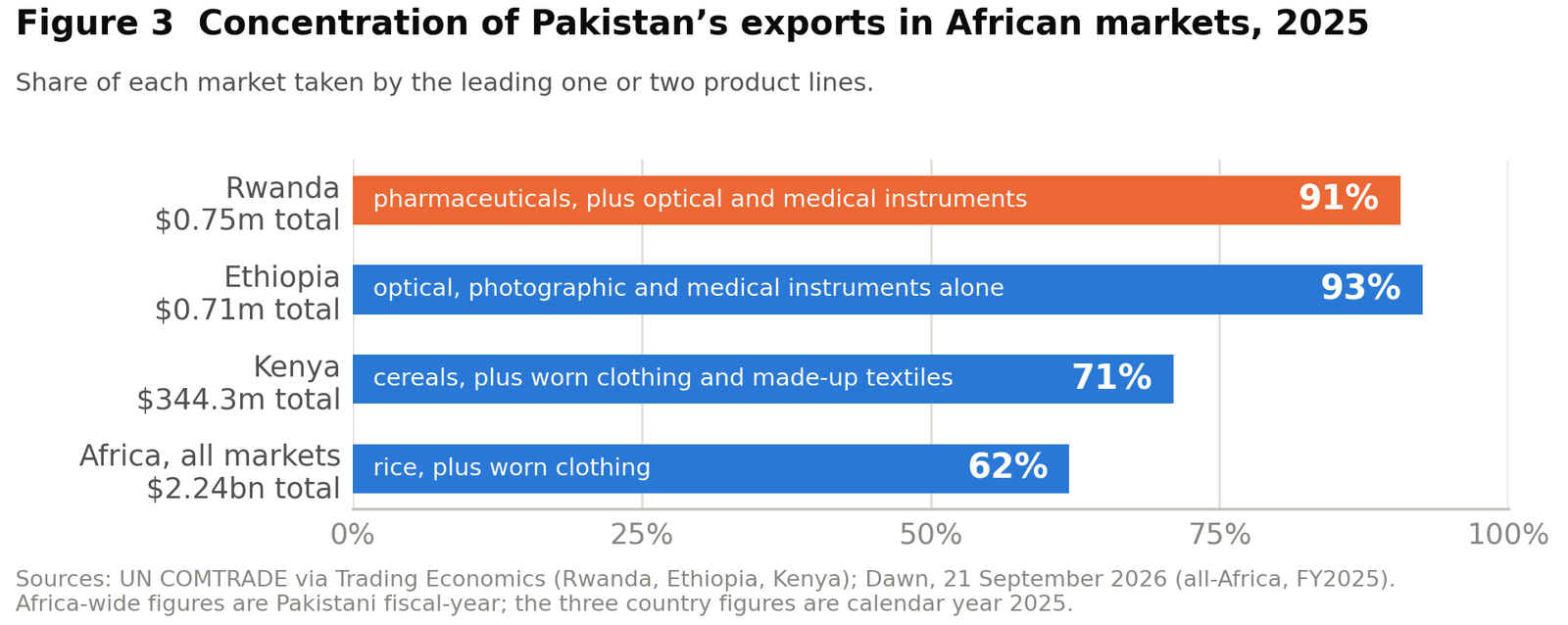
The pattern seen in the Rwanda case runs through Pakistan’s other African markets. Ethiopia took $708,560 of Pakistani goods in 2025, almost all of it in one product category. Kenya looks like the exception at $344.26 million, until cereals and worn clothing are taken out.
Across the continent Pakistan’s exports reached $2.24 billion in FY2025, up from $1.48 billion in FY2020. African economies took about 7 per cent of Pakistan’s $32 billion of exports, which is the measure of the room available.
The assessment made of South African economic diplomacy applies here with little alteration: presence and intent are both in place, and focused priorities are what convert them.
The sequence this case suggests is simple and repeatable. Start where Pakistan already imports in volume, because routes, buyers and commercial habit are in place. Open Pakistani exports first in the sector where the regulatory groundwork at place, so that a result arrives within a year.
Treat the partner as a production base and build the non-commercial links at the same time. Applied to Kenya, the entry point is tea; to Ethiopia, coffee and sesame; to Tanzania, cashew. A $15 billion target will be reached as the sum of such corridors.
6. Proposals
Eight proposals are offered for the first meeting of the Joint Trade Committee. Each can produce a result that anyone can verify within twelve months. Annex A names the responsible institution on each side and the indicator for each item.
Pharmaceuticals. The Rwanda FDA and the Drug Regulatory Authority of Pakistan agree an expedited registration pathway for the seven GMP-listed facilities, with a target number of marketing authorisations issued within twelve months.
Investment and production. The Rwanda Development Board briefs the delegation on the export-conditional regime and names an investor contact. The Joint Business Council holds a first matching session for the four manufacturing sectors identified above.
Rice. Commission one feasibility study on milling or packaging inside Rwanda, tested against the 45 per cent rate in force to 30 June 2027 and against rules of origin. The rate is renewed annually, so the study should be revisited before each renewal.
Payments. Put correspondent arrangements in place between the State Bank of Pakistan and Rwandan commercial banks. This is a precondition for every other commercial item on the list.
Tea. Run a direct-sourcing pilot between NAEB and the Pakistan Tea Association, with a named tonnage, published reference prices, reported volumes and an agreed grading basis. The transparency conditions are the substance of the proposal, not a formality attached to it.
Commercial representation. The relationship needs a resident commercial lead in Kigali. Pakistan’s Ministry of Commerce should post a trade and investment counsellor there and publish that post’s annual work programme.
Defence and peacekeeping. Turn the January 2025 contact into an annual peacekeeping training exchange, including a component on women in specialist roles. Use the same channel for a first briefing on Pakistani equipment in the categories a troop contributor buys and expand it later.
Research, media and implementation. Sign a research memorandum between a Rwandan policy institute and a Pakistani counterpart, set up a content-sharing arrangement with a standing editorial contact in each country, and designate a body to keep a public record of progress against each commitment. That record should be compiled from published sources and issued quarterly, as an input to the Committee’s own reporting rather than a substitute for it.
7. Conclusion
The relationship’s present shape belongs to an early stage: one commodity chapter, one direction, and a route that runs through a third country. A trade instrument creates the conditions in which that shape can change, and the sequence of what follows decides how quickly it does. Presence without priorities produces activity; priorities turn activity into trade.
Rwanda is worth the attention because the openings are visible and the first moves are inexpensive. Seven Pakistani plants stand one regulatory step away from a market. An investment regime already rewards the kind of production Pakistani manufacturers could site there.
Furthermore, there is a huge window of defense cooperation between the two. None of this needs money from either treasury in the first year. The proposals at Annex A are written so that a reader can check, twelve months from now, whether each one was done.
Proposed for the first meeting of the Joint Trade Committee. Each item names a responsible institution on each side and an indicator that can be verified within twelve months.
Item
Rwandan institution
Pakistani institution
Indicator, twelve months
1. Pharmaceutical registration pathway
Rwanda Food and Drugs Authority
Drug Regulatory Authority of Pakistan; the seven GMP-listed firms
An expedited pathway agreed and a target number of marketing authorisations issued
2. Investment and production
Rwanda Development Board
Ministry of Commerce; Joint Business Council
A named investor contact, a delegation briefing on the export-conditional regime, and one sectoral matching session held
3. Rice and agro-processing
Rwanda Revenue Authority; Ministry of Trade and Industry
Ministry of Commerce; rice millers and exporters
One feasibility study completed against the 45 per cent rate in force to 30 June 2027 and against rules of origin
4. Settlement channel
National Bank of Rwanda; commercial banks
State Bank of Pakistan
Correspondent arrangements in place and a first invoice settled without a third-country bank
5. Direct tea sourcing pilot
National Agricultural Export Development Board
Pakistan Tea Association
A named tonnage contracted, with reference prices, volumes and grading basis published
6. Commercial representation
Rwanda Development Board counterpart contact
Ministry of Commerce, trade and investment counsellor in Kigali
Counsellor in post with an annual work programme published
7. Defence and peacekeeping
Ministry of Defence; Rwanda Defence Force
Ministry of Defence; General Headquarters
One pre-deployment exchange held, including a component on women in specialist roles, and a first equipment briefing delivered
8. Research, media and implementation record
A Rwandan policy research institute; Joint Trade Committee secretariat
A Pakistani policy research institute
A signed research memorandum, one joint publication, a standing editorial contact in each country, and a first quarterly progress record published
Muhammad Bilal is a researcher, and Program and Strategic Coordination Officer at the Institute of Peace and Diplomatic Studies, Islamabad. His research interests include diplomacy, global governance and geopolitics, soft power and cultural narratives, and strategic communication. He can be reached at mbilal.research@gmail.com
Our latest analysis, upcoming events and calls for researchers, in your inbox twice a month.
The IPDS Newsletter
Stay informed on diplomacy and global affairs
New analysis from IPDS research centres, invitations to our dialogues and events, and opportunities for researchers. Twice a month, free, and you can leave with one click.