The Strait of Hormuz Crisis and Its Ripple Effects on Pakistan
Written by Momina Fatima
How the Strait of Hormuz turned energy security into a geopolitical weapon and what it cost Pakistan.
Introduction
This crisis has exposed Pakistan’s energy security, specifically in petroleum and gas supply chains. It is viewed as a critical national jeopardy that a hostile state could leverage without direct targeting. Pakistan’s dependence on Qatari LNG and Saudi oil, as the seal of this maritime chokepoint, became an energy security issue, resulting in four-day government workweeks. This crisis should be seen not as an isolated shock but as a strategic warning. This brief argues that the 2026 Hormuz crisis converted energy security from an economic concern into an active geopolitical weapon, with Pakistan standing as the worst-hit country in the crisis. The Strait of Hormuz is the chokepoint leading into and out of the Persian Gulf, and Iran’s coastline borders it. It connects the Persian Gulf to the Gulf of Oman, the only exit route from one of the most oil-rich regions on earth. There is no other way out. Pakistan is struggling to deal with fresh economic shocks as the Middle East war jolts Pakistan’s economy and threatens its oil supply lines.
Energy as Leverage
Pakistan is struggling to deal with fresh economic shocks as the Middle East war jolts Pakistan’s economy and threatens its oil supply lines. The tensions around Iran threatening to choke the Strait of Hormuz, a corridor that carries a large share of Pakistan’s oil imports. A quarter of the world’s seaborne oil trade and a fifth of global LNG supply passed through this narrow waterway between Iran and the Arabian Peninsula.1 Every importer has to rely on the Strait of Hormuz, and there is no other alternative to it. The notion of energy security became significant after the 1973 oil crisis, when the Arab oil producers cut off the oil supply, and there was a big economic crisis, and prices skyrocketed four times higher. Pakistan’s subjugation to this leverage was intense. An official Pakistan government document reviewed by Reuters confirmed that Pakistan depends on the Strait of Hormuz for up to 90 per cent of its combined oil and LNG imports, which is one of the highest single-corridor dependency ratios of an importing nation in the world.2
Impact on Pakistan: LNG Dependence on Qatar and Saudi Oil Rerouting
Pakistan is bracing for an energy crunch as the West Asia conflict threatens a critical oil lifeline, with tensions around Iran raising fears of disruption in the Strait of Hormuz, a route that carries a major share of Pakistan’s fuel imports.3 Islamabad began emergency fuel-saving measures that look strikingly similar to the COVID-19 lockdown. A fragile economy and heavy reliance on foreign loans, and millions of citizens working in the Gulf, whose remittances could also be at risk. Pakistan’s GDP growth for 2026-27 was downgraded by roughly 0.6 percentage points due to the crisis with Bangladesh and was hit even harder at -5% GDP under IMF Hormuz impact models.4 On Gas, Petroleum Minister Ali Pervaiz Malik confirmed Qatar is Pakistan’s largest energy supplier, securing emergency cargoes only after Iran’s strikes on Qatar’s Ras Laffan facility cut 17 per cent of its export capacity. On oil, Pakistan requested Saudi Arabia to reroute crude via Yanbu port, while Kuwait delivered an emergency diesel and jet fuel shipment.5
Geographic Proximity and Emerging Implications
As the crisis began, the impact spread fast. Qatar, the world’s biggest LNG supplier, had its main export facility hit. According to the Pakistan Economic Survey 2025-26, during July-March FY2026, natural gas consumption averaged 2,316 MMCFD, while RLNG consumption remained significant at 613 MMCFD, illustrating dependence on imported gas despite efforts to manage demand and increase domestic supply.6
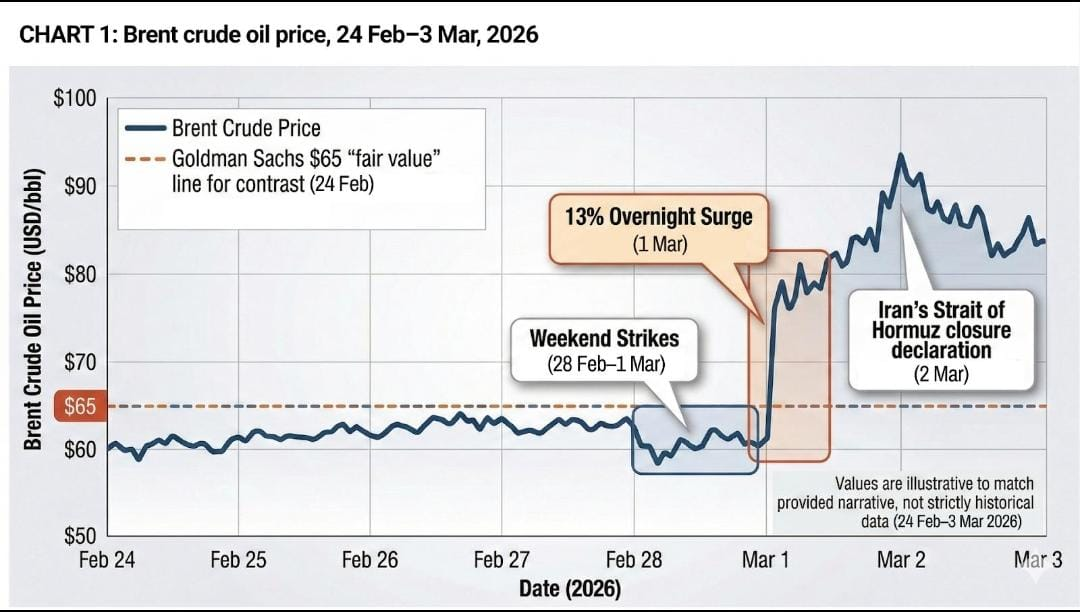
Figure: Brent crude surged over 13% after weekend strikes, hitting a high of $70s—the highest level since January 2025. Goldman Sachs’ $65 fair value suggests a 4-week supply disruption is priced in. Source: Deriv MT5 platform
Macroeconomic Impact and Transmission Channels
Pakistan is bracing for an energy crunch as the Middle East conflict threatens a critical oil lifeline, with tensions around Iran raising fears of disruption in the Strait of Hormuz, a route that carries a major share of Pakistan’s fuel imports. Islamabad began emergency fuel-saving measures that look strikingly similar to the COVID-19 lockdown. With a fragile economy, heavy reliance on foreign loans, and millions of citizens working in the Gulf whose remittances could also be at risk, Pakistan’s GDP growth for 2026-27 was downgraded by roughly 0.6 percentage points due to regional crises, and was hit even harder at -5% GDP under IMF Hormuz impact models.7 A severe risk has been created for electricity generation, transportation, industrial production, and macroeconomic stability resulting due to disruption in shipping through the strait that can affect availability and cost of energy supplies.
The external sector transmission channel emerged, elevating international oil and LNG prices, leading to increasing Pakistan import costs. Pakistan remains vulnerable to fluctuations in global energy prices. The energy supply transmission channels mirrored Pakistan’s growing dependence on imported LNG alongside petroleum products. Fuel prices primarily increased due to oil disruptions, and LNG disruptions further exacerbate physical supply shortages. Similarly, structural vulnerability in the transmission channel exposed Pakistan’s limited strategic reserves and inadequate contingency planning.
Pakistan’s LNG dependence creates liability because Qatar is one of its major LNG suppliers. Any disruptions would affect LNG tanker movement from the Gulf can possibly delay deliveries, increase spot-market prices, and create pressure on Pakistan’s electricity sector, where imported LNG is used to support power generation. Higher LNG and oil prices would also increase Pakistan’s import bill, and can create pressure on foreign exchange reserves, and contribute to inflationary pressures. Maritime insecurity around the Strait of Hormuz also affects broader shipping operations badly. The UK Maritime Trade Operations (UKMTO) has reported multiple security incidents in this Hormuz crisis involving commercial vessels in the region, including tanker and merchant shipping risks. Such disruptions can increase insurance costs, delay vessel movements, and raise freight rates. According to the United Nations Conference on Trade and Development (UNCTAD), disruptions at major maritime chokepoints increase shipping costs globally and create supply-chain pressures, particularly for developing economies dependent on international trade networks.8
Timeline of Escalation
Date
Event
28 Feb, 2026
US and Israeli strikes on Iran begin; IRGC starts closing the Strait of Hormuz in retaliation.
Early March 2026
IRGC lays sea mines and boards merchant vessels; tanker traffic collapses to a fraction of normal levels.
4 March 2026
Facing an acute shortfall, Pakistan formally requests that Saudi Arabia reroute crude oil through the Red Sea port of Yanbu, bypassing the closed strait.
18 March 2026
Iranian strikes damage Qatar’s Ras Laffan LNG facility, the world’s largest liquefaction plant, cutting roughly 17 per cent of Qatar’s export capacity.
24 March 2026
Qatar Energy declares force majeure on a portion of its LNG export contracts.
27 March 2026
The IRGC formally declares the strait closed to any vessel travelling to and from the ports of the US, Israel, and their allies.
May 2026
Qatar Energy repeatedly extends its force majeure declaration, first through mid-June, later through September for major clients such as Italy’s Edison SpA.
May 2026
Pakistan Petroleum Ministry, facing no strategic reserves, begins circulating an official proposal for strategic petroleum reserves and bonded storage.
Policy Recommendations
To strengthen regional energy connectivity and transmission infrastructure by increasing petroleum storage capacity, developing LNG storage and preparing for emergency response, there is a need to establish stronger strategic reserves and crisis management mechanisms.
Remove Bureaucratic Red Tape
In a short-term plan, there is a need to create a one-window energy security fast-track cell with fixed approval deadlines. Measures should be taken by the Ministry of Energy, particularly the Petroleum, Oil and Gas Regulatory Authority (OGRA), and oil marketing companies to focus on improving their emergency coordination mechanism and enhancing fuel stock monitoring.
Diversify Energy Suppliers and Routes
For medium-term measures, there is a need to increase imports from the US, Africa, Latin America, and other viable suppliers. Also, there is an utmost need to develop strategic reserves to reduce reliance on international supply availability.
Future-Proof the Power System Through Renewables and Transmission
Similarly, for a long-term plan, a sense should be created to build a diversified power system where imported LNG cannot become a systemic electricity vulnerability. There is a need to expand renewable energy to reduce import concentration. As the World Bank has mentioned, requirements in the energy sector must improve reliability, reduce vulnerabilities, and support sustainable economic growth.
Conclusion
The closure of the Strait of Hormuz on 28 Feb, 2026 by Iranian forces in response to US-Israel airstrikes on Iran led Iran to pull the trigger on only the most momentous economic weapon in the modern world, which led to more devastation in days than other national militaries could cause in years. Every importer has to rely on the Strait of Hormuz, and there is no other alternative to it. Accessed through a strategic perspective, the Hormuz crisis served as a live-fire test of Pakistan’s energy resilience, and the outcome was unequivocal: a single corridor that accounted for up to 90% of oil and LNG imports, a single dominant gas supplier, and zero foreign strategic reserves deprived Pakistan of direct participation.
The Guardian. What is the strait of Hormuz and why is it crucial for oil supplies? March 1, 2026. theguardian.com [↩]
Momina Fatima is an undergraduate student of International Relations at Quaid-i-Azam University, Islamabad, currently in her seventh semester. Her research interests encompass governance, public policy, strategic and geopolitical analysis, foreign policy, Middle East studies, women’s empowerment, climate activism, regional politics, political representation, and contemporary international affairs. A passionate writer and avid reader, she is particularly interested in examining evolving political dynamics and policy challenges. She can be reached at mominafatimaibex@gmail.com for academic and professional correspondence.
Our latest analysis, upcoming events and calls for researchers, in your inbox twice a month.
The IPDS Newsletter
Stay informed on diplomacy and global affairs
New analysis from IPDS research centres, invitations to our dialogues and events, and opportunities for researchers. Twice a month, free, and you can leave with one click.