Post Bishkek SCO Summit 2026: Decisions, Challenges and Pakistan’s Chairmanship 2027
Written by IPDS Admin
Organized by the Center for SCO Studies, Institute of Peace and Diplomatic Studies (IPDS), Islamabad
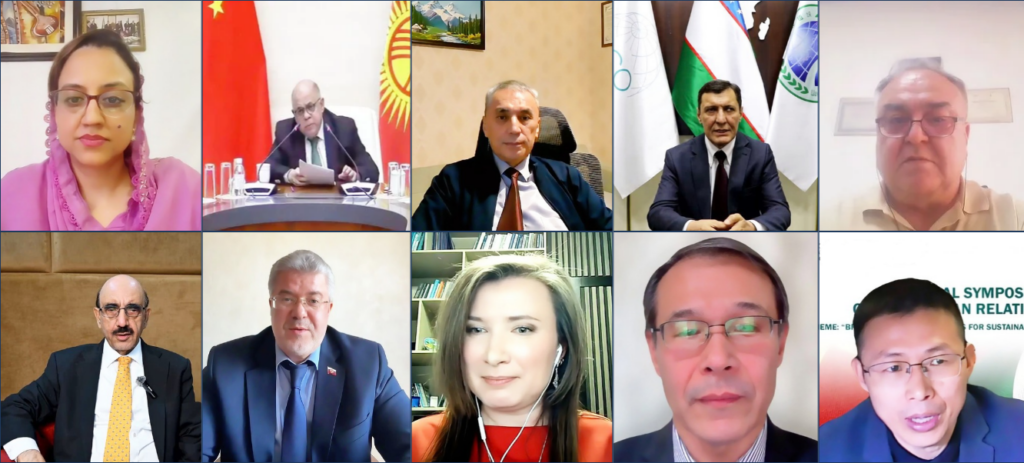
The Center for SCO Studies of the Institute of Peace and Diplomatic Studies organized and hosted a webinar titled Post Bishkek SCO Summit 2026: Decisions, Challenges and Pakistan’s Chairmanship 2027 on 6 October, 2026 via Zoom, at 3pm (Pakistan Standard Time). The speakers of the afternoon were from Russia, Uzbekistan, Tajikistan, China, Kyrgyzstan, Kazakhstan, and Pakistan.
Executive Summary
The Center for SCO Studies at IPDS convened policy experts and academic leaders from seven Eurasian countries to reflect on the outcomes of the Bishkek Summit of the Shanghai Cooperation Organization (SCO), held on S31 August to 1 September 2026, and to look ahead to Pakistan’s chairmanship and the Council of Heads of State Summit in Islamabad in 2027.
Speakers agreed that Bishkek was a milestone Summit of a milestone year for the SCO, as the organization turned 25 on June 15. It produced the Bishkek Declaration and 27 further documents, confirmed a ports and logistics development plan for 2026-2030, adopted a concept for cooperation on artificial intelligence and data centres, and introduced a new “SCO partner” category.
They were equally clear about what remains unfinished, including the proposed SCO development bank, an independent payment system, membership expansion, and deeper economic integration. The central message to Pakistan was that its chairmanship will be judged on its ability to turn political consensus into institutional implementation.
Background and Objectives
The webinar carried on IPDS’s tradition of post-Summit conversations. Last year’s edition, as China hosted the Summit in Tianjin, was joined by the SCO Secretary-General, Nurlan Yermekbayev. The objectives of the session were to:
review the decisions and outcomes of the Bishkek Summit;
identify the challenges that remain before the organization;
bring regional perspectives on Pakistan’s priorities as chair and host of the 2027 Summit.
Program and Speakers
Segment
Speaker
Designation and affiliation
Country
Welcome remarks and moderation
Dr. Farhat Asif
President, IPDS
Pakistan
Keynote address
Ambassador Sohail Khan
Deputy Secretary-General, SCO
Pakistan
Presentation
Prof. Kubanychbek Taabaldiev
Ala-Too International University
Kyrgyzstan
Presentation
Stanislav Korolev
Director, National Center for People’s Diplomacy of the SCO
Russia
Presentation
Prof. Tang Jun
Head, Pakistan Study Center, Inner Mongolia Honder College of Arts and Sciences
China
Presentation
Sheradil Baktygulov
Director, Institute for World Politics Study
Kyrgyzstan
Presentation
Dr. Shamsiddin Karimov
Chief Researcher, Institute for Asian and European Studies, National Academy of Sciences; Director, Tajikistan National NGOs Association
Tajikistan
Presentation
Dr. Lidiya Parkhomchik
Chief Researcher, Institute of World Economics and Politics
Kazakhstan
Pre-recorded video message
Ambassador Masood Khan
Former Ambassador of Pakistan to China and the USA; former Permanent Representative of Pakistan to the UN
Pakistan
Pre-recorded video message
Kabuljon Sabirov
Director, SCO Center for Public Diplomacy
Uzbekistan
Proceedings
Welcome Remarks: Dr. Farhat Asif, President, IPDS
Dr. Farhat Asif welcomed the speakers and participants to the webinar. She recalled that in 2019, a few weeks after that year’s Bishkek Summit, the Center and the Pakistan SCO Friendship Forum convened a roundtable in Islamabad to ask what Bishkek meant for Pakistan. Seven years on, the city is the same, but the challenges and opportunities have changed.
In 2019 Pakistan, which joined as a permanent member alongside India in 2017, was still learning the rhythms of the organization. Today it holds the chair of the Council of Heads of State and will host the 2027 Summit in Islamabad.
She recalled that the 2026 Summit marked the SCO’s 25th anniversary. Leaders signed protocols amending the 2002 Charter, and two new security bodies acquired addresses: the Universal Centre for Countering Security Challenges and Threats in Tashkent, and the Anti-Drug Centre in Dushanbe.
Discussions also covered synthetic drugs, information security, green technology, ports, logistics, business, artificial intelligence, data science and climate change. Lahore was declared the SCO’s tourism and cultural capital for 2026-2027, and she invited participants to visit, repeating the century-old saying that whoever has not seen Lahore is not yet born.
She also pointed to what Bishkek did not settle, chiefly the SCO Development Bank and how it can be established when members run different financial systems. She hoped the conversation would continue through Islamabad and that the bank would be established in the coming years.
Dr. Asif then traced the Center’s own journey. IPDS launched the Pakistan SCO Friendship Forum in March 2015, two years before Pakistan became a full member in Astana, on the belief that society-to-society bridges should not wait for official permission.
In February 2021 it signed an MoU with the SCO Center for Public Diplomacy in Uzbekistan, and in June 2021 another with the SCO Good-Neighborliness, Friendship and Cooperation Commission of China. Its partners also include institutions in Russia, the Pakistan Study Center at Inner Mongolia Honder College, and academic institutions in Tajikistan and Kazakhstan.
The Center has since added a tradition of post-Summit dialogues, an SCO Observatory (a single reference point holding dossiers on the ten members and fourteen institutions) and the SCO Commitment Tracker, which follows whether commitments made are being met. During Pakistan’s chairmanship, she said, the Center wants to contribute meaningfully to the official-level conversation rather than only observe it.
She introduced the keynote speaker, Ambassador Sohail Khan, a career diplomat who has served as Deputy Secretary-General at the SCO Secretariat in Beijing since May 2022, with earlier postings including Moscow and Washington, and called him a pride of Pakistan.
Keynote Address: Ambassador Sohail Khan, Deputy Secretary-General of the SCO
Ambassador Khan thanked the Center for SCO Studies and IPDS for the invitation and apologized for speaking in English, since the SCO’s official languages are Russian and Chinese.
He started by giving a detailed review of the Bishkek Summit and also summed up country-wise proposals that emerged in Kyrgyzstan.
The 26th meeting of the Council of Heads of State was held on September 1 in Bishkek under President Sadyr Japarov, with the heads of delegation of all ten member states taking part. On the eve of the meeting, they attended the opening ceremony of the Nomad Games.
The results were reflected in 28 outcome documents, including the Bishkek Declaration and the Protocol on Amendments and Additions to the Charter, along with provisions on specialized structures. He explained that the anti-terrorist structure based in Tashkent is being refined into several bodies: the Tashkent centre will remain and also deal with transnational crime, and a new centre in Dushanbe will deal with narcotics.
For the first time, a statement on assistance to states affected by disasters was adopted, contributing to President Japarov’s earlier proposal for a special fund or mechanism for emergency assistance. Other outcome documents covered nuclear and physical safety, climate, energy saving and energy systems, drug addiction and synthetic drugs, ports and logistics, biodiversity, digital infrastructure and artificial intelligence. The Summit also decided to sign an MoU between the SCO Secretariat and the African Union Commission.
Alongside common approaches, the leaders’ statements carried specific proposals. These stand at different stages; some are reflected in outcome documents, while others still need coordination and expert-level work.
Kyrgyzstan pushed for the establishment of the SCO Development Bank to finance industrial and infrastructure projects. Belarus proposed an SCO Science Fund for joint research. India expressed readiness to host the first SCO Forum on Dialogue of Civilizations while Iran called for deeper financial and banking cooperation, wider use of national currencies, an SCO Bank, an SCO Export and Investment Insurance Union and an SCO Energy Consortium.
Kazakhstan came forward with proposals of a unified SCO digital transit platform and a transport connectivity strategy to 2035, and a network of AI centers. Pakistan made the case for a framework on sovereign AI infrastructure and AI governance. Russia called for wider use of national currencies in settlements.
Tajikistan proposed coordination on traditional energy (mostly hydropower) and green transition projects, economic growth zones, a regional digital agro-ecological platform, glacier preservation, and water use while Uzbekistan came up with the idea of an industrial cooperation map and an open multilingual SCO data corpus.
The Deputy Secretary General shared that more than 460 events were held across the SCO region over the year, over 150 of them at the Secretariat in Beijing. The chairmanship passed to Pakistan under the theme “Turning Vision into Action: Connectivity, Innovation, and Shared Prosperity”. Ambassador Khan summarized its priorities as:
IT and artificial intelligence: implementing cutting-edge digital solutions and innovation;
Energy: strengthening cooperation and security in the energy sector;
Poverty reduction and development: initiatives for economic growth and against poverty in its different forms;
Humanitarian cooperation: healthcare, culture and education, plus sports cooperation among members;
Regional cooperation: constructive engagement and the peaceful resolution of disputes in the region.
Prof. Kubanychbek Taabaldiev, Ala-Too International University, Kyrgyzstan
Professor Taabaldiev titled his presentation “From Promises to Performance”. He said the Bishkek Summit marks the moment the organization moves from a long period of strategic reflection to institutional implementation, and that the distance between Bishkek and Islamabad is a conceptual bridge as much as a geographical one.
In Bishkek the SCO reaffirmed its commitment to regional stability, economic connectivity and a multipolar security architecture. In Islamabad, he said, it faces a practical question: how to convert political consensus into economic and security mechanisms. He offered three perspectives from Central Asia.
Central Asian paradigms
For Astana, Bishkek, Dushanbe, Tashkent and Ashgabat, the SCO balances traditional security guarantees with new economic vectors. Central Asia practices a sophisticated form of multi-vector diplomacy, and the SCO is not an anti-Western bloc but a stabilizing umbrella for sovereignty, economic diversification and non-military security cooperation. After Bishkek the emphasis has shifted to operational pragmatism in two areas: strengthening the Regional Anti-Terrorist Structure as threats adapt to the digital environment, and modernizing transit so that the Trans-Caspian Corridor and the China-Kyrgyzstan-Uzbekistan railway connect seamlessly to southern gateways.
Structural friction on the road to Islamabad
Declarations, he said, must give way to mechanisms, and three structural problems remain:
Divergent priorities: The SCO has expanded well beyond its Eurasian core. Central Asian members prioritize transit, trade facilitation and non-interference, while others take wider geopolitical views. Bridging this means concentrating on where interests converge most: cross-border energy corridors, digital trade standards and disaster management.
The financing deficit: For more than a decade, proposals for an SCO Development Bank or fund have stalled over banking regulation and capital contributions. Without a unified mechanism the organization cannot underwrite multilateral infrastructure on its own.
Bilateral tension and multilateral inefficiency: Multilateral bodies work only when members keep bilateral disputes off the common table, which is what the “Shanghai spirit” of mutual trust, equality, consultation and respect for diversity asks. Islamabad can concentrate on transit, climate resilience and humanitarian corridors, where shared benefit outweighs political deadlock.
A bridge to South Asia
If Bishkek confirmed Eurasian security coordination, he said, Islamabad should deliver economic synergy between South and Central Asia. Access to the ports of Karachi and Gwadar is a fundamental strategic goal for Central Asia, while Central Asia is an indispensable source of clean energy, minerals and new markets for Pakistan. Three project areas deserve immediate attention:
Energy corridor synchronization: integrating CASA-1000 and the TAP transmission grid into the SCO’s wider energy strategy. With major hydropower advancing in Tajikistan and Kyrgyzstan, stable seasonal power trade is the nearest achievable gain.
Multimodal transit standardization: removing non-tariff barriers, harmonizing customs digitalization across transit states and unifying insurance standards for freight moving from Central Asia to Pakistan’s ports.
Digital and green infrastructure: combining Pakistan’s technology ecosystem with Central Asian digital initiatives to build shared frameworks for e-commerce, environmental monitoring and climate adaptation finance.
In conclusion, he said the SCO stands at a turning point and the world does not need another forum for symbolic declarations. What people from the valleys of Kyrgyzstan to the ports of Pakistan need is operational progress. If Bishkek’s consensus becomes measurable infrastructure and trade outcomes in Islamabad, Eurasian integration will be a genuine anchor of stability and prosperity, and Pakistan has a unique platform to steer the SCO toward concrete economic mechanisms, operational security alignment and stronger trans-regional connectivity.
Stanislav Korolev, Director, National Center for People’s Diplomacy of the SCO, Russia
Mr. Korolev spoke in Russian. He thanked Dr. Farhat Asif and Dr. Asif Noor for preparing the event and for their active role in the SCO agenda, and noted that he had himself attended the anniversary Summit in Bishkek from August 31 to September 1.
The central document was the Bishkek Declaration on the 25th anniversary of the SCO, signed on September 1 after the Council of Heads of State meeting. In it, the participating countries opposed unilateral coercive measures and sanctions that contradict the UN Charter, international law and WTO rules; called for further improvement and reform of global economic governance; condemned the military strikes on Iranian territory and reaffirmed support for Iran’s sovereignty and territorial integrity; and stressed that the SCO is not a military-political bloc. Leaders also signed 27 further documents aimed at strengthening a multipolar world and economic cooperation.
He highlighted the confirmation of the plan for the development of ports and logistics for 2026-2030, the concept of cooperation on artificial intelligence and data centers, and the introduction of a new “SCO partner” category. This category groups the former dialogue partners and observers and gives them the right to apply for membership.
The SCO has come a long way from the “Shanghai Five” of 1996, formed to ensure security and stability along the members’ borders, to an organization covering half of the world’s population and half of the Earth’s surface. He recalled that President Vladimir Putin told the Council of Heads of State that over 25 years the SCO has grown into one of the independent and influential centers of the emerging multipolar world.
Mr. Korolev also set out what Bishkek left open. Despite the simplified joining procedure, no expansion of the SCO was announced, owing to a number of unresolved internal issues. Five of the six Gulf monarchies (Bahrain, Qatar, Kuwait, the UAE and Saudi Arabia) hold SCO partner status, yet their delegations were absent from Bishkek. He said that “the issues of creating a single SCO development bank and an independent payment system remained unresolved.” These and many other issues, he said, will have to be addressed in the coming years.
He congratulated the people and Government of Pakistan on taking up the chairmanship and hoped the 2027 Islamabad Summit would be a new milestone for the organization and for the system of international relations.
Prof. Tang Jun, Head, Pakistan Study Center, Inner Mongolia Honder College of Arts and Sciences, China
Professor Tang Jun’s presentation, “Vision and Action: The Prospects for Pakistan’s SCO Chairmanship”, asked how far Pakistan can translate its chairmanship theme into practice and sustainable outcomes. He looked at the available foundations, the major constraints and the outcomes Pakistan can realistically pursue.
Pakistan links South Asia, Central Asia, Western China and the Arabian Sea, with Karachi, Port Qasim and Gwadar as maritime gateways. The planned Uzbekistan-Afghanistan-Pakistan railway runs about 760 kilometers and is meant to connect Central Asia to Pakistan’s ports. In September 2026 Pakistan proposed a joint financing coordination mechanism for it, giving the chairmanship a practical project around which transport, customs, logistics and financing can be coordinated.
CASA-1000 represents about US$1.2 billion of investment and is designed to carry 1,300 megawatts from Central Asia to South Asia, of which Pakistan is to receive 1,000. The World Bank expects the Afghanistan section to be completed by the end of 2027, so implementation overlaps closely with the chairmanship.
ICT export remittances reached US$3.38 billion in the first nine months of fiscal year 2025-26, up 19.7% year on year. In September 2026 Pakistan proposed an SCO digital governance and AI capacity-building network, together with a digital connectivity and compute corridor, opening a new area of practical coordination within the SCO.
He also identified three constraints that Pakistan faces. First being the Trans-Afghan railway and CASA-1000 both depend on a stable security environment there. CASA-1000’s Afghan section was previously suspended and resumed construction only in late 2024, and Pakistan itself continued to face a serious domestic security challenge in 2026. Security affects transport costs, insurance, investment and project delivery.
As a second constraint, the Professor pointed out India-Pakistan relations. Both are SCO members but the relationship remains difficult, and linking CPEC and Pakistan’s ports to wider Eurasian cooperation requires careful diplomacy. Technical cooperation on customs, logistics, digital trade, transport and standards may offer more workable ground for consensus.
He then pointed to the fiscal capacity as the IMF projects Pakistan’s real GDP growth at 3.6% for 2026-27, with government debt around 70.1% of GDP. He suggested Pakistan prioritize mechanisms with long-term value over summit-related spending.
Realistically, he said, Pakistan can deliver three things: a digital governance mechanism, a transport infrastructure financing mechanism and a Central Asia port and logistics mechanism. He proposed three indicators for judging the chairmanship: whether long-term mechanisms are established, whether concrete projects move to the next implementation stage, and whether measurable increases appear in trade, investment and digital cooperation.
Sheradil Baktygulov, Director, Institute for World Politics Study, Kyrgyzstan
Mr. Baktygulov called the Summit a milestone because of the 25th anniversary, held under the slogan “Joining Hands Towards Sustainable Peace, Development, and Prosperity”. He noted that the webinar was the first event on the subject and offered five points.
The Bishkek Declaration is the most significant political document of the Summit. It summarizes 25 years of SCO achievements, reaffirms the UN Charter, stresses a more just and equitable multipolar order, and commits members to implementing the strategic plan adopted at the 2025 Tianjin Summit. The protocol amending the Charter gives a legal basis for optimizing decision-making and for tackling traditional and non-traditional security threats. English is also set to become an official SCO language, as the leaders agreed in Bishkek.
Security cooperation remains a core pillar. Regulations were approved for the SCO Comprehensive Center for Countering Security Threats and Challenges and for the Executive Committee of the Anti-Drug Center, completing the legal frameworks for the Tashkent and Dushanbe bodies. A center to combat transnational organized crime is planned in Bishkek, where the Kyrgyz side has finished the infrastructure preparation. The Summit also adopted an anti-drug cooperation plan through 2030, including a program against synthetic drugs and their precursors.
Members reaffirmed their commitment to industrial collaboration, transport connectivity, modern logistics and digital solutions, and agreed to accelerate consultations on the SCO Development Bank. A ports and logistics development plan for 2026-2030 was adopted, and the China-Kyrgyzstan-Uzbekistan railway is set to open new corridors. In emerging sectors, the Summit adopted a concept paper on regional data centers and computing capacity, an MoU on AI cooperation and an international information security cooperation plan to 2028.
The Summit adopted an initiative on biodiversity conservation with a joint action plan to 2031, a plan for scientific and technological cooperation on an SCO green technology corridor, and an MoU on climate change cooperation. Lahore was designated SCO capital of tourism and culture for 2026-2027.
The Summit decided to sign an MoU between the SCO Secretariat and the African Union Commission. Egypt, an SCO partner, took part in Bishkek, the SCO has been granted observer status with the CIS, and roadmaps have been approved for cooperation with the CSTO and the Eurasian Economic Commission.
He concluded that Pakistan will take the rotating presidency for 2026-2027 and will focus on connectivity in transport, trade, energy and digital fields, the responsible development of AI, and deeper security and counter-terrorism cooperation.
Dr. Shamsiddin Karimov, Chief Researcher, Institute for Asian and European Studies, National Academy of Sciences; Director, Tajikistan National NGOs Association, Tajikistan
Dr. Karimov said the world is changing rapidly and old international rules no longer work as they used to. The SCO, he argued, is becoming a true leader of the Global South and a key pillar of a multipolar world, and the Bishkek Summit proved that global stability depends directly on peace in Central Asia.
Central Asia is often seen as an arena for great-power competition, and security there is usually discussed in terms of hard power: armies, borders and joint counter-terrorism. That is a vital foundation, he said, but hybrid and digital threats cannot be solved by military force alone, which is why soft power and civil society matter more than ever. The most practical approach is to focus on shared non-political challenges such as climate change, water management and youth education.
Civil society builds people-to-people ties, which are far more stable. When universities exchange students, think tanks cooperate with government institutions and cultural forums bring people together, mutual distrust falls. NGOs also work on the ground to build “information immunity” among young people, which matters in a region where almost all countries are young: in Tajikistan around 80% of the 10.5 million population is under 35. Civil society helps shift attention from geopolitical competition to practical regional cooperation.
He described Tajikistan’s open-door foreign policy under President Emomali Rahmon and its use of public diplomacy within the SCO. Examples include the Global Water Initiative and the regular Dushanbe Water Conferences, which bring together scientists, youth and civil society from around the world, and the UN General Assembly’s proclamation, on Tajikistan’s initiative, of the International Decade of Strengthening Peace for Future Generations (2027-2036).
He named three practical ways civil society can help the SCO secure Central Asia:
Track II public diplomacy: think tanks, university exchanges and youth forums that build trust and reduce political tension.
Digital literacy: in an era of information warfare, NGOs should teach young people to use the internet safely, preventing radicalization and protecting secular values.
Climate and water cooperation: environmental groups are crucial to the Dushanbe water process, and melting glaciers and climate change could cause future resource conflicts, so civil society can help states find green, peaceful solutions.
In conclusion, he said that as the SCO moves toward Islamabad it needs a new, broader view of security. Members must keep a practical balance: strengthen their military perimeters while investing heavily in human capital, culture and public institutions, which he called the combined strategy that will make the SCO a strong shield of stability for Central Asia, Greater Eurasia and future generations.
Dr. Lidiya Parkhomchik, Chief Researcher, Institute of World Economics and Politics, Kazakhstan
Dr. Parkhomchik welcomed the habit of discussing Summit outcomes a few weeks after the event, which leaves time to reflect. She said the 2026 Summit confirms that cross-border crises require international cooperation and that the SCO is emerging as a key player in the wider Eurasian region.
SCO members account for over 15% of global trade, and Kazakhstan’s own trade with SCO members reached nearly US$72 billion in 2025. The updated SCO development strategy to 2035 lets the organization move beyond a security focus to a broader agenda, she said, with modernized economic cooperation the most effective way to adapt to changing conditions.
She noted that 28 documents were approved at Bishkek, including regulations for the Center for Countering Security Challenges and Threats and rules for the Executive Committee of the Anti-Drug Center.
Security remains at the heart of the SCO’s institutional framework, and Kazakhstan attaches critical importance to the program of cooperation against terrorism, separatism and extremism until 2027. Regional stability in Central Asia still depends on the Afghan issue, which the Regional Anti-Terrorist Structure monitors through the SCO-Afghanistan Contact Group.
Digital and hybrid threats also challenge stability, and Kazakhstan advocates stronger monitoring and counter-measures in the information space, including an SCO Center for Information Security. Astana has also advanced an SCO initiative on world unity for just peace, harmony and development.
The multilateral trade and economic cooperation program to 2035 and the SCO Economic Development Strategy to 2030 are the key guiding documents. Mutual trade among members is forecast to reach about US$720 billion this year. She made three points on where coordination matters most:
Investment synergy: Kazakhstan argues that the absence of a project financing mechanism is a main reason economic cooperation is weak. Astana continues to lobby for a Joint Investment Fund, followed by a portfolio of joint projects, and sees a clear investment framework coming with the launch of the SCO Development Bank and its relationship with the existing Interbank Consortium.
Cross-border transport connectivity: SCO countries have about 348,000 kilometers of railway carrying around 8.2 billion tons of freight a year, and roughly 13 million kilometers of roads, including about 15,000 kilometers of motorways. The region brings together major Eurasian routes, including the Belt and Road, the Northern Railway through Russia, the Trans-Caspian route and the North-South corridor. Kazakhstan wants the SCO to play a stronger role in supply-chain stability and to develop a transport connectivity strategy to 2035, and it welcomed the agreed roadmap on ports and logistics centers to 2030.
Energy cooperation: The proposed Energy Club has been put on hold, but members have other initiatives, mostly on electricity generation and renewables. Kazakhstan, which targets carbon neutrality by 2060, wants to use the SCO platform to expand its green energy portfolio.
She said the SCO could become a coordination center for a broad network of regional economic initiatives, but integration is still proceeding unevenly and the ten members are not ready for a supranational economic mechanism. Projects are mostly delivered through interdepartmental cooperation, ministerial consultation and bilateral arrangements, and the Charter legally allows a shift from multilateral to bilateral formats.
She called the resulting institutional flexibility positive: not all ten members need to move at the same pace, and a multi-speed model lets projects start with a limited group of participants without waiting for general consensus.
Pre-recorded Video Message: Ambassador Masood Khan, former Ambassador of Pakistan to China and the USA and former Permanent Representative to the UN
Ambassador Khan said it is a great honor for Pakistan to host the SCO Summit next year. He recalled that Pakistan also hosted the 23rd meeting of the Council of Heads of Government in October 2024, an important diplomatic milestone that marked Eurasian solidarity and produced decisions on opposing protectionism, reforming multilateral trade and alternative trade settlement systems.
Of Bishkek, he said the Summit called for an immediate ceasefire in the Middle East, rejected unilateral sanctions and expressed zero tolerance for terrorism. It also decided to establish a center to counter transnational crime, promote transit projects and advance proposals for an energy consortium, and it decided to add English as an official language. He thanked Kyrgyzstan and the SCO for naming Lahore the SCO tourism and cultural capital.
Pakistan takes the chair, he said, while a multi-front war in the Middle East is affecting the continent, the Russia-Ukraine war continues and supply chains are disrupted. Pakistan itself suffers from the consequences of terrorism along its western borders and from the unilateral suspension of the Indus Waters Treaty. With less than a year to prepare, Islamabad has already begun multilateral coordination through the first Council of National Coordinators meeting in late September.
He listed the priorities within the chairmanship theme as digital trade, multimodal transit corridors, infrastructure development, AI governance and expanding economic cooperation, adding that new technological developments should not leave SCO members behind. He suggested the 2027 Summit could:
serve as a launch-pad for economic and security cooperation and deliberate on operationalizing Eurasian transit networks that link CPEC with Central Asian states, giving them direct access to the Arabian Sea,
host the operational rollout of the Universal Center for Countering Challenges and Threats, to support regional intelligence sharing and cross-border counter-terrorism protocols,
build SCO-wide consensus on a unified climate and water framework covering trans-boundary water management, disaster preparedness and green technology,
review progress on the SCO Development Bank, whose framework was approved in 2025 and which will coexist with the Interbank Consortium rather than absorb it, working alongside the AIIB and the BRICS New Development Bank.
The Summit, he said, will highlight the role of multipolar diplomacy in integrating Eurasia and Islamabad’s emergence as a “safe and trusted diplomatic hub” and a stable, responsible stakeholder able to manage complex multilateral diplomacy. It will again dispel the impression that the SCO is a mere talking shop and provide a neutral platform for regional de-escalation where adversaries can come under one roof.
He added that the SCO is not “the NATO of the East” but a platform for a multipolar world order that advocates a strong United Nations and international rule of law, with members committed to opposing terrorism, separatism and extremism.
Pre-recorded Video Message: Kabuljon Sabirov, Director, SCO Center for Public Diplomacy, Uzbekistan
Mr. Sabirov apologized for not joining live because he was attending the SCO Regional Anti-Terrorist Structure conference in Minsk, Belarus, and offered his reflections in a video address. He congratulated Pakistan on assuming the chairmanship and assured IPDS of his center’s readiness to support and take part in initiatives during it.
He said Bishkek carried special significance because it came as the SCO marks 25 years, from a mechanism for building trust and stability to one of the largest and most influential regional organizations, uniting countries with different political systems and cultural traditions. From a public diplomacy perspective, he highlighted the symbolism of the Summit opening alongside the World Nomad Games.
In his view, combining a high-level political forum with a major cultural and sporting event showed how heritage, sport and people-to-people contacts complement traditional diplomacy, and was a vivid example of soft power that “needs no translation”.
He drew attention to three initiatives put forward by Uzbekistan’s President Shavkat Mirziyoyev at the Council of Heads of State and the SCO Plus format:
“SCO 2040: A Space of Common Development,” a long-term conceptual vision to guide cooperation in security, economy, connectivity and humanitarian affairs.
A 2028-2030 cooperation program on traditional arts and intangible cultural heritage, covering crafts, music, oral traditions and festivals as instruments for bringing peoples closer and building trust between generations.
A permanent SCO Plus Forum of Cultures and Civilizations, a regular platform for dialogue, cultural exchange and joint initiatives that would extend the SCO’s experience to partners and observers.
The future of the SCO, he said, lies not only in security and economic cooperation but also in people-to-people ties, cultural dialogue and public diplomacy. He congratulated Pakistan on Lahore’s designation as SCO Tourism and Cultural Capital for 2026-2027, expecting it to bring more tourists, artists, scholars and young people from SCO countries.
Looking toward Islamabad, he urged deeper practical cooperation and wider exchanges among youth, experts, media and civil society, so that the SCO spirit of mutual respect, equality and consultation is visible to ordinary people. He expressed confidence that Pakistan will pursue all its objectives during its chairmanship and that deliverables from earlier summits will become real projects.
Closing Remarks
Dr. Farhat Asif said one thread ran through the afternoon; acting on promises. When Islamabad convenes the Summit in 2027, she hoped the commitments made over 25 years would begin taking shape, with institutional frameworks and joint answers to common regional threats built on consensus.
She said IPDS would keep growing alongside the SCO, from the Friendship Forum of 2015 to the Center, the Observatory and the Commitment Tracker, and invited participants to explore IPDS’s nine centers, its Scholars Network and Non-Resident Fellowship Program.
She thanked Ambassador Sohail Khan for sharing the Secretariat’s perspective, each speaker for their contribution, and the registered audience. She said the recording would be shared and a summary published on the IPDS website and The Diplomatic Insight.
Ambassador Sohail Khan closed by thanking the organizers and participants for their views on the SCO’s trajectory, encouraging participants to stay in touch with their national coordinators in their foreign ministries.
Key Themes and Takeaways
From consensus to implementation: Speakers from Kyrgyzstan, China and Kazakhstan all stressed that Pakistan’s chairmanship will be judged by concrete, operational progress rather than declarations.
Connectivity and logistics: The ports and logistics plan for 2026-2030, the China-Kyrgyzstan-Uzbekistan railway, CASA-1000 and links between Central Asia and the Arabian Sea through CPEC featured across several interventions.
Economic integration and financing: The SCO development bank, an independent payment system and a joint investment fund were raised as needs, with integration described as a work in progress and flexible bilateral projects suggested in the meantime.
Digital transformation and AI: The new concept on AI and data centres, Pakistan’s proposal on AI governance and digital governance mechanisms were seen as areas where Pakistan can lead.
Security and stability: Speakers pointed to security as a core pillar, the Afghanistan question as central to regional stability, and the need for a broader, human-centred view of security.
Public diplomacy: Civil society, Track II diplomacy, youth digital literacy, culture and sport were presented as stabilizing and complementary to formal diplomacy.
Multipolarity and the Global South: The SCO was described as a balancing tool and a leader of the Global South, with the caution from the keynote that multipolarity should not create new dividing lines.
Recommendations
Pakistan should translate political consensus into institutions and measurable steps, judged by whether long-term mechanisms are set up, projects move into implementation, and trade, investment and digital cooperation grow.
Priority should go to bridging South and Central Asia through power corridors, multimodal transit and harmonized customs.
The SCO should consider a joint investment fund, progress on the SCO Development Bank alongside the existing Interbank Consortium, and bilateral projects where two members are ready to move ahead.
Pakistan can realistically deliver a digital governance mechanism, a transport infrastructure financing mechanism and a Central Asia port and logistics mechanism, and advance responsible AI development.
Civil society should be involved through Track II diplomacy, digital literacy and climate and water cooperation.
Pakistan should adopt a new view of security that invests in human capital and public institutions.
Culture, sport and public diplomacy should be used alongside formal diplomacy.
The webinar brought together voices from seven countries around a shared assessment: Bishkek delivered a strong set of documents and a clear signal of multipolar cooperation, but the organization’s next phase depends on implementation.
With the Islamabad Summit scheduled for 2027, the discussion set out both the opportunities Pakistan can build on, from connectivity and energy to AI and public diplomacy, and the constraints it will need to manage. The Center for SCO Studies at IPDS intends to continue tracking these commitments through its SCO Observatory and Commitment Tracker.
Our latest analysis, upcoming events and calls for researchers, in your inbox twice a month.
The IPDS Newsletter
Stay informed on diplomacy and global affairs
New analysis from IPDS research centres, invitations to our dialogues and events, and opportunities for researchers. Twice a month, free, and you can leave with one click.