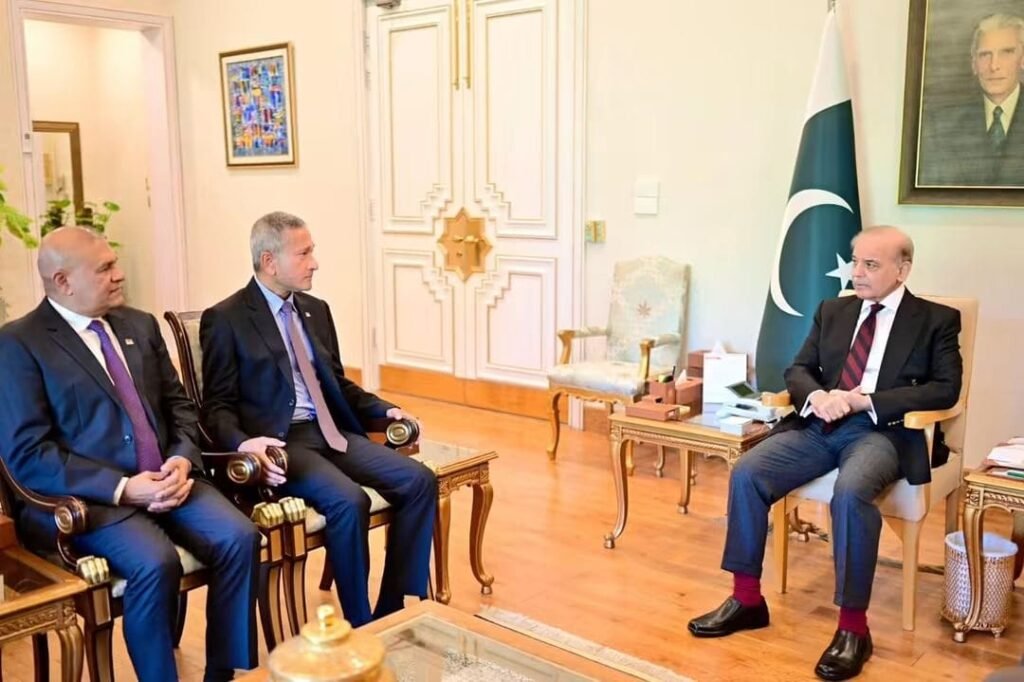
Singapore’s Foreign Minister, Vivian Balakrishnan, spent 30 October in Islamabad. He held talks with Deputy Prime Minister and Foreign Minister Ishaq Dar. He then called on Prime Minister Shehbaz Sharif and Field Marshal Syed Asim Munir, the Chief of Defence Forces. Balakrishnan thanked both for their efforts to de-escalate tensions in the Middle East. He also visited the National Centre of Artificial Intelligence at the National University of Sciences and Technology. The visit marked sixty years of diplomatic relations. It also came shortly before Singapore takes the chair of the Association of Southeast Asian Nations (ASEAN) in 2027.
At the joint press conference, Balakrishnan commended the “incredibly valuable role” that Pakistan is playing as the Gulf crisis unfolds. He also noted that Pakistan is “already a sectoral dialogue partner” of ASEAN. He then said that Singapore would look for opportunities for Pakistan to do more with the grouping.
Those words point to a real opening. Full dialogue partner status remains Pakistan’s stated ambition, and it is a sound one. The surer route to it runs through a documented program of joint work. ASEAN has also made the terms of that route clearer than at any time in the past three decades.
The aspiration, and what ASEAN now measures
Pakistan became a sectoral dialogue partner on 23 July 1993, and it acceded to the Treaty of Amity and Cooperation on 2 July 2004. Both ministers drew attention to that seniority in Islamabad. Dar called Pakistan ASEAN’s oldest sectoral dialogue partner, and Balakrishnan called it one of the earliest. Full status sits a step above. ASEAN decides by consensus, so an upgrade needs the agreement of all ten members. Pakistan does have support inside the grouping. Malaysia’s prime minister, Anwar Ibrahim, said in June 2025 that the request would be brought up for discussion at the leaders’ conference.
July 2026 brought the larger change. ASEAN’s foreign ministers met in Manila on 21 July and adopted a List of Criteria and Indicators for Dialogue Partnership. The list supplements Annex A of the 2014 Guidelines for ASEAN’s External Relations. The ministers also agreed to keep discussing how to put that process into practice, along with the standing moratorium on new dialogue partnerships. Their senior officials had already been asked to carry the review forward in a decision adopted in Kuala Lumpur on 9 July 2025. For any applicant, published criteria are a considerable advance on a closed door.
The same Manila meeting accorded Türkiye the status of dialogue partner. The ministers did so taking into account its engagement with ASEAN since becoming a sectoral dialogue partner in 2017. That phrase deserves close reading. Türkiye reached the sectoral tier twenty-four years after Pakistan, yet it advanced first. What counted was the engagement that followed. Türkiye signed free trade agreements with Singapore and Malaysia. It also built a near-complete network of missions across the region, as an analysis on the ISEAS-Yusof Ishak Institute’s FULCRUM platform records. Before Türkiye, the United Kingdom had ended a twenty-five-year moratorium when it became ASEAN’s eleventh dialogue partner in August 2021.
The underlying logic is well established. Moe Thuzar set it out in ISEAS Perspective in 2017. ASEAN’s external partnerships rest on what a partner can contribute to the grouping’s own development. Dialogue partners usually commit funding and technical support to particular ASEAN initiatives. Even sectoral partnerships call for substantive cooperation built up over time.
The commercial track has moved more slowly than either side would have wished. ASEAN’s economic ministers agreed a moratorium on Pakistan’s free trade proposal at their meeting in Manado in August 2011. Pakistan’s separate talks with Singapore began in 2005 and stalled after four rounds.
Read More: Pakistan – ASEAN Relations Tracker
A record that is gathering pace
Measured against the new criteria, Pakistan’s record is still being built, though it is moving in a good direction. The joint committee met on 2 November 2017 and then not again until 19 September 2023, six years later. It met again on 6 February 2025, and the ninth meeting followed in Jakarta on 29 June 2026. Funded cooperation projects show a similar shape. The same ASEAN overview lists none between November 2014 and 2022. After that gap come a short diplomatic course, a digital payments program, two business conferences and a media exchange.
The room for growth is wide. Two-way trade between ASEAN and Pakistan reached $10.74 billion in 2025, a rise of 2.76 percent on the year before. Balakrishnan was candid in Islamabad about the bilateral figure. He said trade with Pakistan ought to be much higher, and he called that the first order of business.
What Singapore wants from its year in the chair
Balakrishnan set out his priorities on 7 October at the Milken Institute Asia Summit. He spoke about deeper economic integration within ASEAN, and about broadening the grouping’s external ties. He named the European Union, Africa, South America, Canada and the Pacific Islands. Pakistan did not appear on that list, though the priorities were drawn in broad terms. His remarks in Islamabad three weeks later added more of the picture.
A chair with a full agenda will favor work that is concrete and ready to start, and Pakistan is now well placed to offer it. The framework is already in place. ASEAN and Pakistan adopted practical cooperation areas for 2024 to 2028 on 12 February 2024, so it runs straight through Singapore’s year in the chair. The ninth joint committee meeting reviewed it in June. Both sides identified opportunities in maritime security and exchanged views on possible collaboration on disaster management.
Now consider what the Islamabad visit produced. The memorandum exchanged between Pakistan’s National Disaster Management Authority and the Singapore Civil Defence Force is broader than its title suggests. Singapore’s foreign ministry lists four areas: early warning systems, best practice on disaster risk reduction, search and rescue capability, and regular joint training and exercises. Singapore has done this kind of work in Pakistan before. ISAS notes that it ran a reconstruction project after the 2005 earthquake. In May the two ministers discussed maritime affairs and agreed to coordinate closely. The visit added other strands as well, among them the reopening of Pakistan’s Trade and Investment Office in Singapore, exploratory work on carbon markets, and university links involving NUST.
Two of the areas ASEAN raised in June now carry a documented Singapore connection. That gives the partnership a natural place to start.
Read More: ASEAN and the South China Sea
A Practical Agenda for 2027
Three proposals follow. The first is to take the memorandum to the ASEAN table. Pakistan could propose a joint disaster-management project under the sectoral partnership and name the Singapore Civil Defence Force as its partner. The four areas already agreed would give the project its content. The second is a maritime security dialogue, built on the May call and on the opportunities identified in June. The third is to invite Singapore to co-host the next ASEAN-Pakistan business conference. ASEAN’s overview lists two so far, in August 2023 and April 2025, both funded through the ASEAN-Pakistan Cooperation Fund.
None of these is large. Each one can be measured, and each sits inside a framework that already exists. Each also speaks to the contribution that ASEAN’s new criteria are designed to assess. Both sides could name a lead agency for every project and report against it at the next joint committee meeting. Good intentions would then turn into a record that ASEAN can check for itself.
Conclusion
Full status would bring Pakistan into the summit-level forums, and it remains a goal worth pursuing. The 2011 moratorium on the free trade proposal is a reminder that the commercial track asks for patience. A record of delivered projects is likely to prove more persuasive than any single request.
This approach may look modest. It is better seen as a down payment, offered at a moment when the terms have finally been published. Singapore stands to gain as well. A chair looking for partners beyond its usual circle is well served by a willing one with projects ready to begin. Both ministers said in Islamabad that they would build on the momentum of the visit and follow up in good time. Singapore’s year in the chair is a promising moment to do exactly that.
Muhammad Bilal
Muhammad Bilal is a researcher, and Program and Strategic Coordination Officer at the Institute of Peace and Diplomatic Studies, Islamabad. His research interests include diplomacy, global governance and geopolitics, soft power and cultural narratives, and strategic communication. He can be reached at mbilal.research@gmail.com