Pakistan’s Eurasian Opportunity
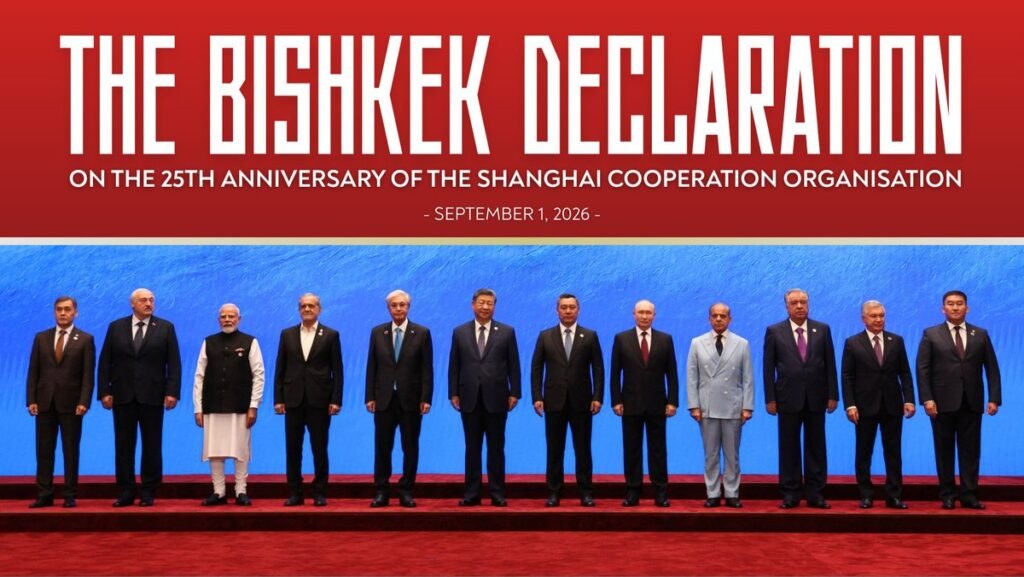
Pakistan has assumed the chairmanship of the Shanghai Cooperation Organisation at a moment when Eurasia requires political imagination backed by practical delivery. The responsibility handed over in Bishkek places Islamabad at the centre of a vast community of major powers, emerging economies, energy producers, transit states and more than three billion people. For Pakistan, this is far greater than a rotational diplomatic assignment. It is an opportunity to shape the next phase of regional cooperation.
Prime Minister Muhammad Shehbaz Sharif has defined the 2026–2027 chairmanship through the theme “Turning Vision into Action: Connectivity, Innovation and Shared Prosperity.” The choice of words carries significance. During its first twenty-five years, the SCO built political confidence, expanded its membership and created an extensive institutional structure. Its second quarter-century must produce visible improvements in trade, transport, technology, security and human development.
Pakistan’s geographical position gives this ambition strategic credibility. It connects South Asia with China, Central Asia, Iran and the Arabian Sea. Its ports can offer Central Asian economies shorter access to global maritime routes, while the China-Pakistan Economic Corridor provides infrastructure around which wider regional connections can grow. Geography has already given Pakistan the map. Its chairmanship can help provide the movement.
The first priority should be to transform connectivity into a functioning economic system. Roads and railway lines acquire strategic value when supported by efficient customs procedures, compatible transit regulations, digital documentation, banking channels and reliable border management. The SCO can provide the political coordination required to bring these elements together.
The Trans-Afghan Railway deserves a central place in this effort. A railway linking Uzbekistan through Afghanistan with Pakistan’s seaports would offer Central Asia an important southern trade route. It could also create employment, attract investment in logistics and industry, and give Afghanistan a productive stake in regional stability. Pakistan can use its chairmanship to convene governments, financial institutions, railway authorities, port operators and private investors around an implementation framework.
Afghanistan remains vital to the future of Eurasian connectivity. Its stability affects Pakistan, Central Asia, China, Iran and the wider SCO region. Prime Minister Shehbaz Sharif used the Bishkek platform to call for effective action against terrorist groups operating from Afghan territory. This concern deserves a coordinated regional response combining security engagement, economic participation, humanitarian support and sustained diplomacy.
Pakistan brings painful experience and professional knowledge to the security agenda. More than 90,000 Pakistani lives have been lost to terrorism, alongside economic losses estimated at over $150 billion. Islamabad’s leadership of the SCO Council of the Regional Anti-Terrorist Structure gives it an established platform for strengthening intelligence cooperation, joint training, border security, action against terrorist financing and collective responses to cyber-enabled extremism.
The security institutions approved at Bishkek can support this effort. The Universal Centre for Countering Challenges and Threats and the Executive Committee of the SCO Anti-Drug Centre can help member states address terrorism, organised crime, narcotics trafficking and emerging transnational risks. Pakistan’s chairmanship can focus these institutions on measurable cooperation and regular threat assessments.
The most forward-looking element of Pakistan’s agenda is its proposal for an SCO Sovereign Artificial Intelligence Infrastructure and Governance Framework. This initiative responds to one of the defining questions of our time: whether technological advancement will narrow development gaps or deepen them.
An SCO framework can promote responsible artificial intelligence, strengthen digital sovereignty and expand access to technological capacity across member states. It can complement China’s announcement of 100 science and technology projects over the next three years, along with proposed centres for artificial intelligence applications and basic education cooperation.
Pakistan has a young population, an expanding digital economy, capable universities and a growing technology sector. It can connect these strengths with the SCO through joint research, start-up partnerships, scholarships, digital-skills programmes and applied artificial intelligence projects. Agriculture, healthcare, disaster forecasting, water management and public services offer immediate areas for cooperation.
Prime Minister Shehbaz Sharif also announced that Islamabad will host the Global Resilience Expo during Pakistan’s chairmanship. This initiative could become one of the most practical outcomes of the year. SCO countries face floods, droughts, earthquakes, glacier loss, extreme temperatures and growing pressure on food and water systems. A regional expo bringing together governments, scientists, disaster-management agencies, businesses and humanitarian organisations could generate partnerships in early warning, emergency response and climate-resilient infrastructure.
Water cooperation deserves equal prominence. At Bishkek, the Prime Minister described water as the lifeblood of the region and emphasised the binding character of agreements governing shared rivers. Across Eurasia, population growth, glacier loss and climate disruption are increasing pressure on freshwater resources. Scientific cooperation, data sharing, early-warning mechanisms and responsible treaty implementation can help protect regional peace.
The chairmanship also offers Pakistan an opportunity to give greater energy to poverty reduction, health, culture and sports. These priorities matter because regional cooperation gains public confidence when its benefits reach households, students, workers and small businesses. The SCO’s future strength will grow through social relevance alongside diplomatic weight.
Lahore’s designation as the SCO Tourism and Cultural Capital for 2026–2027 gives Pakistan an exceptional platform for people-to-people engagement. The city’s history, architecture, literature, cuisine and intellectual traditions can introduce the SCO community to the cultural depth of Pakistan. A year-long programme of festivals, exhibitions, university dialogues, media exchanges and youth forums can also bring Eurasia closer to Pakistani society.
Pakistan’s diplomatic engagements in Bishkek further strengthened the foundation for its chairmanship. Prime Minister Shehbaz Sharif held discussions with President Sadyr Japarov on trade, investment, energy, education, tourism and connectivity. Kyrgyzstan pledged support for Pakistan’s leadership of the organisation. Meetings with President Shavkat Mirziyoyev of Uzbekistan, President Aleksandr Lukashenko of Belarus and UN Secretary-General António Guterres reflected Islamabad’s wider effort to connect bilateral partnerships with multilateral priorities.
The 2027 SCO Council of Heads of State Summit in Islamabad will provide the culminating moment of Pakistan’s tenure. The most meaningful measure of success will be the progress achieved before the leaders arrive. A transport initiative entering implementation, an operational AI cooperation framework, stronger security coordination and a regional resilience mechanism would give the Islamabad Summit enduring value.
Pakistan has received the chairmanship at a consequential point in the SCO’s evolution. Its greatest contribution can be the creation of a culture of delivery. By connecting Central Asia with the Arabian Sea, technology with development, security with opportunity and diplomacy with implementation, Islamabad can give practical expression to the Shanghai Spirit.
This is Pakistan’s Eurasian opportunity. Wise leadership can turn it into a shared achievement for the entire SCO community.
*The writer is President, Institute of Peace and Diplomatic Studies and has a PhD thesis on Pakistan’s Membership of the Shanghai Cooperation Organisation: Opportunities and Scope for Public Diplomacy.