A decade of research, dialogue and institution-building on China's global engagement and the Belt and Road Initiative — a dozen MoUs, a co-founded research alliance, and a live tracker of Pakistan-China relations.
The Centre for BRI and China Studies is one of the Institute of Peace and Diplomatic Studies' (IPDS) constituent centres of study, dedicated to examining China's global engagements, particularly through the Belt and Road Initiative (BRI). It serves as a platform for research, policy discussions and academic collaboration to analyse China's economic, political and strategic role in global affairs.
The Centre was formally launched on 31 January 2022 with Riphah International University, at the Riphah Institute of Public Policy in Islamabad — building on IPDS programming on China and CPEC that dates back to 2015. Since then it has signed thirteen MoUs and partnership agreements with Chinese and Pakistani institutions, co-founded the Alliance of China-Pakistan Research Centres (14 member centres across both countries), and convened over thirty research events, seminars and dialogues.
The Centre's work follows the Pakistan–China relationship as it moves from CPEC's infrastructure-heavy first phase into "CPEC 2.0" — industrialisation, agriculture and technology — alongside China's twelve-consecutive-year run as Pakistan's top trading partner. Its flagship output, the Pakistan–China Relations Tracker below, gives policymakers, diplomats, researchers and the public a sourced, current reference on diplomatic engagement, trade and investment, infrastructure and security cooperation.
As part of IPDS — an autonomous, non-partisan think-and-do tank headquartered in Islamabad — the Centre's work has been cited independently by Xinhua, China Daily and Global Times, and its leadership regularly represents IPDS at China-Pakistan Track II dialogues.
Research on China's foreign policy, economic strategies, and global influence.
Analysing the impact of the Belt and Road Initiative on global trade, infrastructure, and regional connectivity.
Examining China's role in international organisations, global governance, and development initiatives.
Engaging policymakers, academics, and industry experts in dialogue on China-related affairs.
A decade of institution-building: MoUs, a launched Centre, a co-founded research network, a co-published book, and a landmark 2025 Track II dialogue — each item sourced to IPDS's own records or independent press.
Two seminars — "Seminar on BRI and Regional Development" and "Seminar on CPEC and Central Asian States" — convened in partnership with Preston University. Surfaced from IPDS's own Facebook photo archive; exact date not confirmed, so shown undated rather than guessed.
View source →Cooperation agreement with a major Chinese publishing house to co-publish books, booklets, magazines and research on Chinese culture in English and Urdu.
View source →Cooperation agreement with Obortunity to promote public awareness of CPEC and the Belt and Road Initiative across Pakistan.
View source →Joint research agreement with the University of Peshawar's China Study Centre on the Belt and Road Initiative and China Studies, signed by Farhat Asif and Vice Chancellor Prof. Dr. Muhammad Asif Khan.
View source →Research and academic-exchange agreement with a Pakistan Research Center operating under China's Ministry of National Education, and a commitment to grow the Friends of Belt and Road Initiative Forum.
View source →Partnership to build graduate skills for CPEC projects and launch a joint Chinese-language initiative.
View source →IPDS and Riphah International University establish the Centre at the Riphah Institute of Public Policy, Islamabad — building on IPDS's China and CPEC programming dating back to 2015.
View source →Academic and research collaboration agreement with COMSATS University Islamabad's China Study Centre to boost China-Pakistan academic and research links.
View source →Online launch bringing together seven Pakistan Research Centres based in China and seven CPEC/China study centres based in Pakistan — a standing research network the Centre helped found.
View source →Signed in Kashgar, China at the 3rd Muztagata Forum; covers joint CPEC/BRI research, conferences and faculty/student exchange.
View source →Co-published with the Pakistan Research Center at Inner Mongolia Honder College and hosted with the Riphah Institute of Public Policy.
View source →Jointly organised with the Academy of Contemporary China and World Studies (China International Communications Group); included a joint survey on "Chinese Modernization" across five SCO states, with senior Chinese and Pakistani diplomats in attendance.
View source →Three-year agreement for joint seminars, research and training with the CPEC Center of Excellence at BUITEMS, Quetta.
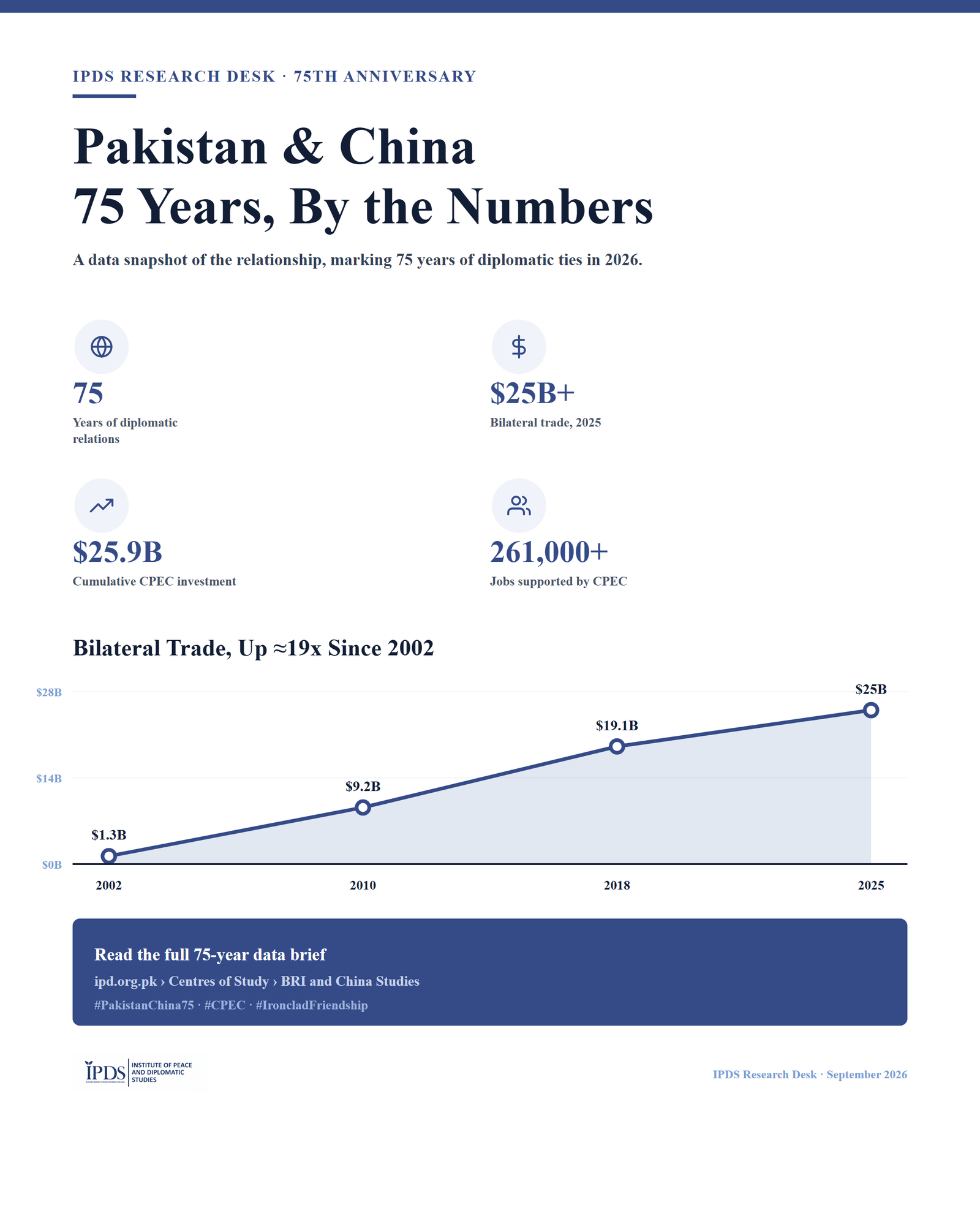
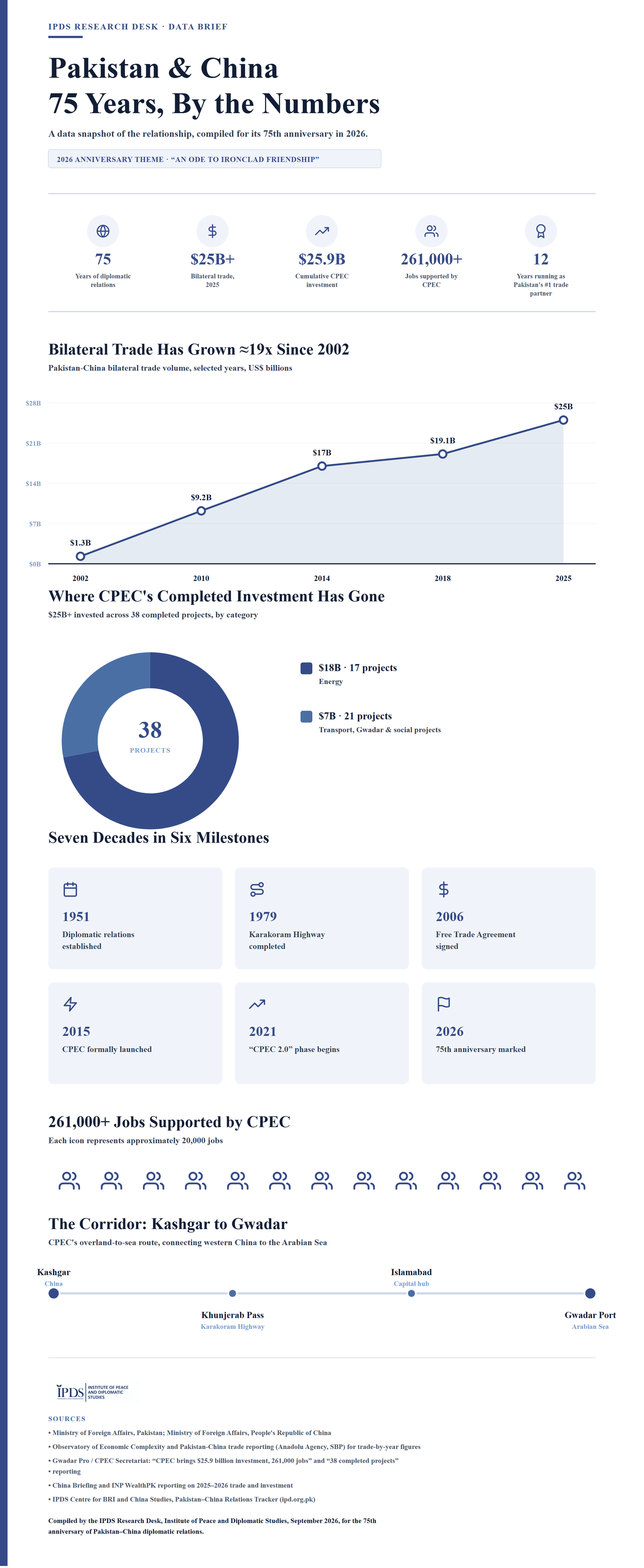
View source →Marking 75 years of diplomatic ties in 2026: bilateral trade growth, CPEC investment by sector, jobs supported, six defining milestones and the corridor connecting Kashgar to Gwadar — all in one sourced infographic.
Free to share and repost on social media, with attribution to the IPDS Centre for BRI and China Studies.
Looking for the full picture? Pakistan-China Relations: A 75-Year Reference →
The Centre's flagship, primary-source reference — every embassy and consulate, trade and CPEC data, defence cooperation and more, since 1951.
Pakistan-China relations, anchored for over a decade in CPEC, marked their 75th anniversary in 2026 with a high-level visit cadence — President Zardari and PM Shehbaz Sharif both travelled to China within months of each other — and a formal shift from CPEC's infrastructure-heavy first phase to "CPEC 2.0," oriented toward industrialisation, agriculture and technology. China has been Pakistan's largest trading partner for twelve consecutive years and, per SIPRI, supplied over 80% of Pakistan's arms imports 2021-2024. This is a living reference, revised as new agreements, visits and data are published.
2026 marked the 75th anniversary of Pakistan-China diplomatic relations, marked by a dense visit schedule: President Asif Ali Zardari made a five-day state visit to China covering industrial, agricultural and water-desalination cooperation and CPEC 2.0; PM Shehbaz Sharif separately travelled to Hangzhou for what China's Foreign Ministry called an "important high-level exchange," where he and Premier Li Qiang witnessed the signing of multiple MoUs. (Friday Times, Express Tribune)
The 7th round of the China-Pakistan Foreign Ministers' Strategic Dialogue (January 2026) agreed to align development priorities and accelerate CPEC 2.0; subnational cooperation has also expanded, including a trade and investment delegation from China's Loudi City. (Express Tribune)
China has been Pakistan's top trading partner for twelve consecutive years; bilateral trade exceeded $25 billion in 2025. China supplied 53.2% of Pakistan's total foreign direct investment between July 2025 and February 2026. (INP WealthPK)
Cumulative Chinese investment under CPEC stands at $25.93 billion, credited with over 261,000 jobs, 510km of road infrastructure, 886km of core power-transmission grid, and 8,000+ MW of power generation capacity. (Gwadar Pro)
CPEC has formally shifted from an infrastructure-heavy first phase to "CPEC 2.0" — industrialisation, agriculture, technology and private-sector-driven growth. Completed flagship projects include the 1,320MW Sahiwal coal plant, the 1,000MW Quaid-e-Azam Solar Park (Bahawalpur), the Multan-Sukkur motorway section, and Lahore's Orange Line Metro.
Underway: the 1,124MW Kohala Hydropower Project, the 300MW Gwadar coal-fired power project, continued Gwadar Port expansion (deep-water berths for large cargo/oil vessels), and Gwadar International Airport. (China Briefing)
Pakistan and China hold one of Asia's closest defence partnerships, built on co-production of major weapons systems (notably the JF-17 Thunder) and extensive training exchanges. Per SIPRI data, over 80% of Pakistan's arms imports between 2021-2024 came from China.
The "Warrior-IX" joint counterterrorism exercise ran 28 Nov–14 Dec 2025 at Pakistan's National Counter Terrorism Center in Pabbi, covering mixed-group training and live-fire drills; both sides have since reaffirmed plans to deepen cooperation on intelligence-sharing, border security and defence technology. (Arab News, Pakistan Today)
How to cite: IPDS Centre for BRI and China Studies, "Pakistan–China Relations Tracker," Institute of Peace and Diplomatic Studies, last revised September 2026.
This is an early version of this tracker (first published September 2026) and will be expanded with further sourced detail over time. Spot an error or an update we've missed? Suggest a correction.

34 roundtables, seminars, webinars and symposia convened since 2015 with partners including COMSATS, BZU, the University of Peshawar, the Pakistan Broadcasters Council, China Economic Net, Inner Mongolia Honder College and the Zhejiang provincial government — grouped by year, most recent first.
| First Virtual Symposium on China-Pakistan Relations, with Minhaj University | 19 Sep 2025 |
| A Decade of CPEC: Building Connectivity and Regional Integration | 28 Dec 2023 |
| Webinar on China-US Relations, with Riphah Institute | 07 Jul 2023 |
| China Pakistan Media Forum 2021 — Strengthening China-Pakistan Relations Through Informed Dialogue | 27 Sep 2021 |
| Webinar: How Can BRI Help Afghanistan — Views from the Globe | 24 Sep 2021 |
| 100 Years of the Communist Party of China: Global Perspectives | 16 Jul 2021 |
| Webinar: Cementing Business to Business Connections Through BRI | 08 Jul 2021 |
| Webinar: Strengthening Media Cooperation Through Belt and Road Initiative | 26 May 2021 |
| Academic Partnerships for Shared Growth under the Belt and Road Initiative | 07 May 2021 |
| China's Rural Revitalization: A Model for Inclusive Growth | 02 Apr 2021 |
| First Virtual Friends of BRI Forum (with InZhejiang & Cooperans Europe) | 03 Feb 2021 |
| Interactive Session on China–Pakistan Economic Corridor with Civil Society Organizations | 28 Aug 2015 |
The Centre's leadership and research have been cited independently by major Chinese and international outlets — distinct from IPDS's own commentary on its sister outlet, The Diplomatic Insight.
Farhat Asif on Chinese vaccine cooperation and CPEC's resilience through COVID-19, at the SCO Forum on People-to-People Friendship, Wuhan.
Read →Farhat Asif quoted on China's "community of shared future" vision amid vaccine diplomacy.
Read →Farhat Asif interviewed on the Belt and Road Forum's 10th anniversary and CPEC's tangible results.
Read →Independent coverage of the Centre's "A Decade of CPEC" webinar, featuring Farhat Asif and BUITEMS' Abdul Sattar.
Read →Farhat Asif quoted at the China International Fair for Trade in Services (CIFTIS) on digital and services-trade opportunities.
Read →Op-ed by Muhammad Asif Noor, "Link of Friendship," marking 75 years of China-Pakistan relations and the shift to CPEC 2.0.
Read →No insights published yet under this Centre. Check back soon.
For research collaboration, media enquiries, or to propose a contribution to the Centre's work on China and the Belt and Road Initiative, get in touch with the IPDS research desk.