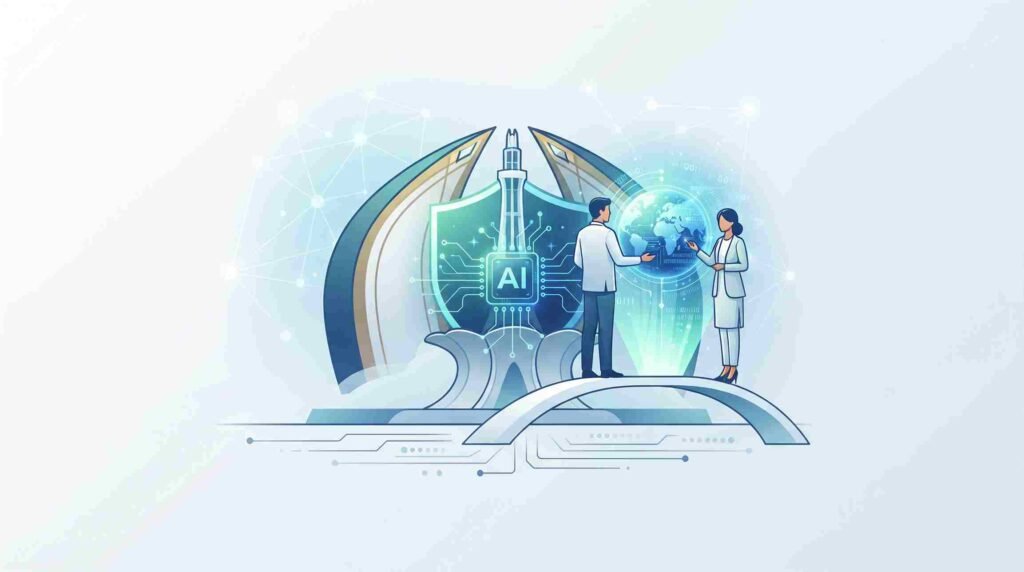
Artificial intelligence is changing the way countries communicate, manage information and protect their interests. For Pakistan, the real challenge is no longer whether to enter the digital age, but how to make technology work for its diplomacy. That question sits at the heart of AI diplomacy.
Traditionally, diplomacy has been based on communication. Throughout centuries, nations have used ambassadors, negotiation, correspondence, printed media and personal connections for expression of their views and protection of national interests. That traditional approach has changed in the contemporary age.
Today, a statement by a representative of the government from Islamabad can be received by the audience in Washington, Beijing, London or Riyadh instantly.
A Pakistani embassy may communicate to the global audience without any need to wait for coverage in the international press. But at the same time, disinformation and deception can spread equally fast, and sometimes even faster than truth. Pakistan has already made some efforts to deal with the situation: it adopted the National Artificial Intelligence Policy in 2025, developed the National Cyber Security Policy, and created digital diplomacy initiatives.
The National Cyber Security Policy of Pakistan 2021 offers a more comprehensive approach towards improving the country’s cybersecurity environment. It focuses on cybersecurity governance and institutional capability; protection of information systems and critical information infrastructure; cyber threats detection and response; cybersecurity awareness and competence; research and development; and coordination nationally and internationally (MoITT, 2021).
The National Artificial Intelligence Policy 2025 of Pakistan offers a general framework on aspects like AI skills, R&D, infrastructure, responsible AI use, AI applications in the public sector, and international cooperation.
The policy framework could be augmented with more specific institutional mechanisms in relation to Pakistan’s foreign policy and diplomacy communication, in terms of dealing with disinformation generated through artificial intelligence technologies such as deepfake and synthetic media (MoITT, 2025).
All these developments occur alongside the increasing utilization of digital footprint in Pakistan’s foreign diplomatic communications. According to the ministry, the creation of its Strategic Communications Division took place in 2020 with an objective of updating the communication toolkit of the Foreign Office in terms of making it technologically oriented.
At the same time, the missions of Pakistan abroad have a coordinated presence on such social media platforms as X, Instagram, LinkedIn, YouTube, and Facebook (Ministry of Foreign Affairs, n.d.). The Foreign Office conducted certain capacity-building activities in the sphere.
Thus, according to MOFA, in February 2022, 130 Pakistani diplomats serving in 100 missions abroad took part in a “Twitter for Diplomacy” training session organised with the Digital Media Wing of the Ministry of Information and Broadcasting (MOFA, 2022).
It is evident that digital diplomacy has been firmly incorporated into the practice of Pakistan. The emergence of generative AI, synthetic media, and disinformation based on the use of AI technologies adds another dimension of challenges to a digital diplomacy environment.
The New Face of Diplomacy
The Foreign Office of Pakistan and its diplomats use social media like X, Facebook, Instagram, YouTube, and LinkedIn in order to reach out to international audiences. But digital diplomacy involves much more than just communicating through social media.
News outlets report on events, governments issue their statements, think-tanks release analysis reports, universities conduct research, and millions of people discuss international affairs through social media. No matter how capable the diplomatic corps may be, it cannot keep up with all these developments manually.
Imagine a program that will constantly scan international news and social media and inform the decision makers of Pakistan whenever a certain narrative about Pakistan starts to become popular in different countries. Consider the case in which diplomats from Pakistan are able to process hundreds of international documents at high speed and recognize what needs to be addressed.
It does not need to replace the diplomats but it can help them to make better use of their time and information. Diplomacy will always need the involvement of human beings with their skills of judgment and politics, as well as negotiation abilities. The machines cannot create the trust that is built by two ambassadors nor understand all nuances of the relationships.
Deepfakes Are Changing the Rules of Diplomacy
One of the worst things that happen along with the development of generative artificial intelligence is that of deep fakes. Citizens find it difficult to ascertain the authenticity of a video, photo, or an audio clip that comes across their way.
Think about what would happen if a convincing fake video showed a top official of Pakistan making a statement about the foreign policy of the country; within moments, the video could become viral on various social media platforms, and even before the government could deny its veracity, millions of people would have seen it.
An invented statement concerning India, Afghanistan, China, America, or any other important ally of the country could create trouble for the diplomatic relations. Therefore, Pakistan needs to have the capacity to detect AI misinformation quickly and take appropriate measures. Such action should not come only after the spread of misinformation, but it should be part of the monitoring system itself.
The Foreign Office, information bodies, cyber security agencies, and Pakistani embassies abroad need to clarify the responsibility for verification, identify the routes through which the replies will be sent, and identify the mechanism by which the international media will be notified. In the age of technology, timing is essential because even a delay of a few hours in the government’s response to a fabricated video can enable the misleading story to spread far and wide.
Read More: Litigation and International Arbitration in the Age of Artificial Intelligence
Cybersecurity Is Becoming Part of Diplomacy
The importance of increasing focus on cybersecurity needs to be emphasized. There is sensitive information in a foreign ministry, and diplomatic correspondence can involve negotiations, security issues, politics, and discussions with other nations.
Therefore, any potential cyber attack on these systems will have a wider scope than being an issue of IT, and there might be consequences of this in foreign policy. While Pakistan already has a National Cyber Security Policy, the incorporation of cybersecurity into its regular operations is crucial.
It is necessary to conduct regular training of diplomats in regard to being careful about potential phishing attacks, securing accounts, suspicious links, password protection, and being safe from AI tricks. Furthermore, there should be strong security measures to protect the accounts of Pakistani embassies abroad. Due to the fact that cyber-attacks are becoming increasingly sophisticated, the idea that cybersecurity is the problem of the IT department alone is no longer possible.
The Real Challenge
Contemporary diplomacy entails skills going beyond the traditional foreign policy; now, diplomats need to know about the social media, AI, cybersecurity, misinformation, and how the algorithms affect the online visibility and conversations. However, this does not mean that all diplomats need to become computer scientists; what it means is that some technological knowledge needs to be part of modern diplomatic education.
In Pakistan, this has been achieved through digital diplomacy training, and the next step would include wider courses in AI, cybersecurity, digital communications, and information verification. A diplomat working in Beijing, Washington, Brussels, Riyadh, or any other international city needs to have at least some basic knowledge of the technology discussions relevant for that particular country.
The regulation of AI now takes place in the sphere of foreign policy; so does cybersecurity, data, and technology investments. These cannot be considered purely technical questions anymore.
Pakistan Needs to Think About Technology Diplomacy
Pakistan has certain policies relating to artificial intelligence and cybersecurity, and the Foreign Office has already initiated digital diplomacy activities. What needs to happen right now is improved coordination among different agencies. Pakistan needs to have an organization in its Foreign Office that can help deal with emerging technologies and digital diplomacy issues.
t needs to do more than just manage the social media accounts of the ministry. The organization should help keep track of technology trends, advise policymakers, work with technology experts, and help the Pakistan missions tackle new digital challenges.
There could be five major categories here.
- AI and foreign-policy analysis: using technology to understand international developments and emerging narratives.
- Cybersecurity: protecting diplomatic institutions and sensitive information.
- Strategic communication: responding to misinformation and communicating Pakistan’s position more effectively.
- Technology and economic diplomacy: promoting Pakistani IT, AI, startups and digital services abroad.
- Global AI diplomacy: ensuring that Pakistan has a meaningful voice in international discussions about AI governance, cybersecurity and responsible technology.
Pakistan Must Avoid a New Kind of Dependency
There is another problem that Pakistan cannot afford to overlook. The majority of the world’s most advanced AI technology infrastructure is owned by a small number of companies and technologically developed nations.
Pakistan needs to form technology partnerships with other countries, and this is nothing to worry about, in fact, it is essential. But being dependent is problematic if the nation does not manage to build enough local capability.
Pakistan needs to develop local expertise, protect critical data, enhance cybersecurity, and build diverse technology partnerships abroad. It is crucial for the country to be able to use the technology from other nations without becoming entirely dependent on it.
A Different Kind of Public Diplomacy
Technology could also play an important role in helping Pakistan shape its narrative. For a long time, the story about Pakistan in the international community has largely been one focused on issues of security, instability, and regional problems.
Although these are valid issues to highlight, they do not represent all of the country. Pakistan is made up of researchers, entrepreneurs, students, technologists, artists, companies, and innovative youth who make great contributions. Digital diplomacy provides Pakistan with the opportunity to tell these stories directly to the international community.
The caveat to this is credibility. Doubt in government propaganda is growing, and mere production of more content will likely not improve Pakistan’s image. A more effective approach to taking action would involve telling these stories via credible sources, real success stories, and real partnerships.
When a Pakistani university makes an important discovery, that story needs to be told. When a Pakistani startup enters the international market, that success needs to be shared. When Pakistani scientists are part of artificial intelligence research, they need a voice. When a Pakistani tech company offers its services internationally, that needs to be shown. Public diplomacy does not always fit in a slogan.
From Digital Presence to Digital Influence
Pakistan has already entered the age of digital diplomacy. The next move would be to move from being digitally present to being digitally influential. Simply having an account on social media would not suffice. Just putting out statements would not suffice. Waiting until disinformation has already gathered momentum and then responding to it is also not enough.
What Pakistan needs is the ability to predict, analyze, communicate, and react. AI is not some sort of magic wand that would solve all the problems of Pakistan’s diplomacy; it is a tool. Like all tools, its effectiveness will depend on who uses it and how it is used. AI should support, not replace, diplomatic judgment.
The diplomat of tomorrow will still require political acumen, negotiation skills, cultural sensitivity, and human judgment. Moreover, that diplomat will require an understanding of AI, algorithms, cybersecurity, and the rapidly changing digital information ecosystem.
The country has already made progress in the development stage through the implementation of AI policies, cybersecurity frameworks, and digital diplomacy. The country’s embassies need to act not only as centers for diplomacy but also for technologies, investment, research, and international cooperation.
The diplomats of the country need to be ready not only for negotiations within conference halls but also to understand the digital information environment. The path of diplomacy goes further than digitalization; it includes intelligence, connectivity, cyber-resilience, and ever-growing impact of artificial intelligence.
AI-based diplomatic activities would need extensive cooperation between government departments, cybersecurity agencies, universities, research centers, and the corporate sector. The Ministry of Foreign Affairs (MOFA) needs to give strategic direction and coordinate the international activities of Pakistan regarding AI diplomacy, and help the country respond to any AI-based challenges that arise.
The Strategic Communications Division of MOFA can keep an eye on international digital narratives and coordinate all public communications, whereas diplomats in the respective countries can keep track of all emerging trends.
The MoITT can provide technical advice and guidance as well as ensure that the diplomatic efforts remain in line with the National AI Policy 2025. Cybersecurity agencies can help with the monitoring of threats, risk assessment, digital forensics, and response management where AI-enabled manipulation is intertwined with cyber threats.
The research institutions can contribute their expertise in deepfake, AI-generated disinformation, and reactions of the citizens to the synthesized media, and also give specialized training to diplomats and governmental officials. Technology firms can supply the technical know-how, AI tools for detection and verification, as well as solutions for detecting manipulated content.
Pakistan now needs to treat artificial intelligence not only as a technological issue but also as an emerging part of diplomatic strategy and communication security.
The Foreign Office should consider establishing a dedicated AI and Digital Diplomacy Unit with clear guidelines, trained staff, verification procedures, and formal links with cybersecurity institutions, MoITT, universities, research centres, and technology companies.
Such a unit could monitor AI-related threats, support Pakistani diplomatic missions, coordinate responses to synthetic media, and contribute to international discussions on responsible AI governance. Rather than creating a parallel system, the proposed unit could build on Pakistan’s existing digital diplomacy structures and strengthen their capacity to operate in a rapidly changing information environment.
This would help the Foreign Office protect the credibility of official communication while making more effective use of AI as a tool for diplomatic engagement.
References
Ministry of Foreign Affairs, Government of Pakistan. (n.d.). Public diplomacy. https://www.mofa.gov.pk/public-diplomacy
Ministry of Foreign Affairs, Government of Pakistan. (2022, February 16). Training session on digital diplomacy. https://mofa.gov.pk/training-session-on-digital-diplomacy
Ministry of Information Technology and Telecommunication, Government of Pakistan. (2025). National Artificial Intelligence Policy 2025. https://www.moitt.gov.pk/Policies
Ministry of Information Technology and Telecommunication, Government of Pakistan. (2021). National Cyber Security Policy 2021. https://moitt.gov.pk/SiteImage/Misc/files/National%20Cyber%20Security%20Policy%202021%20Final.pdf
United Nations Security Council. (2025, September 24). Artificial intelligence and international peace and security: Security Council, 10005th meeting. United Nations. https://transcripts.un.org/en/sc/10005
Associated Press. (2025). Impostor uses AI to impersonate Rubio and contact foreign and US officials. https://apnews.com/article/1b3cc78464404b54e63f4eba9dd4f5a9
Associated Press of Pakistan. (2025, September 25). At United Nations, Pakistan pushes for UN Charter’s oversight of Artificial Intelligence (AI). https://www.app.com.pk/foreign-correspondent/at-united-nations-pakistan-pushes-for-un-charter-s-oversight-of-artificial-intelligence-ai/