Executive Summary
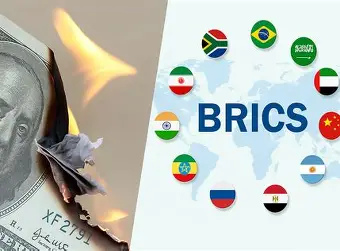
Every few years, someone announces the end of the dollar. Every few years, the dollar carries on. In the second quarter of 2026 it still made up 56.7% of global foreign-exchange reserves. In April 2025 it sat on one side of 89.2% of all currency trades. BRICS de-dollarization is not really about knocking it off that perch. Now eleven members strong, the group is doing something quieter and more practical. It is building extra ways to pay, borrow and settle, so that no single currency or pipeline holds all the power. This brief makes one argument. BRICS will shape global finance through gradual diversification, not dramatic de-dollarization. That is the more realistic goal, and for most developing economies it is also the more useful one. The sections below explain why the dollar is so sticky, what BRICS is actually building, where the limits lie, what the bloc should do next, and what it all means for Pakistan.
1. A Dollar-Centered World
The dollar does several jobs at once. It is a reserve asset, a trading currency, an invoicing currency for global commerce, a funding currency for borrowers and the denomination of countless financial assets. Very few currencies do even one of these at global scale.
The reserve numbers show a slow slide, not a collapse. The dollar’s share has drifted down from the exceptional levels of earlier decades, yet at 56.7% it remains far ahead of the renminbi, which holds only a small slice.
Currency markets tell an even stronger story. The BIS Triennial Survey found the dollar on one side of 89.2% of foreign-exchange trades in April 2025, up from 88.4% in 2022. That matters because FX turnover is more than a measure of central-bank taste. It shows which currency the world uses as the bridge between all the others.
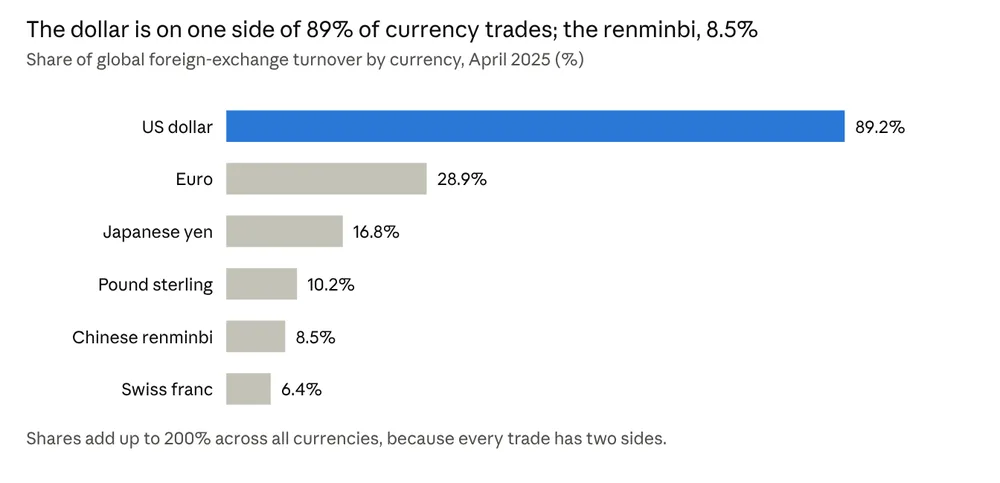
Source: Bank for International Settlements, Triennial Central Bank Survey 2025 (April 2025 turnover)
Even the renminbi, the strongest BRICS candidate, appears in fewer than one trade in ten. Trade invoicing is just as sticky. IMF research covering 132 countries from 1990 to 2023 found that invoicing patterns stayed broadly stable and dollar-led, despite geopolitical fragmentation and the renminbi’s rise. Changing the currency of a contract means changing the habits of firms, banks and markets all at once.
The reason is network effects. A currency used for trade attracts financial contracts. Financial use brings liquidity. Liquidity draws central banks and firms to hold it, and those holdings feed back into trade. Each link strengthens the next. Underneath it all sit US Treasuries, a vast pool of safe assets that investors can buy and sell at scale. No other market offers that combination.
Infrastructure adds another layer. SWIFT does not choose currencies and does not settle payments; it is a messaging network. But it grew up around a Western-centered system, which is why access to it can become a geopolitical question. For emerging economies, this adds up to a trade-off. Dollar dependence brings liquidity and market access. It also brings exposure to US interest rates, dollar swings and political decisions made elsewhere.
2. Why BRICS Wants Options
The impulse behind BRICS finance is not hostility to the dollar. It is risk management. The question many members are asking is simple: what if we had a Plan B?
That question sharpened in March 2022, when designated Russian institutions were cut off from SWIFT. The episode showed that financial plumbing can double as a tool of statecraft. Even countries with no quarrel with Washington took notice.
The group has also grown, which raises the stakes. It began with Brazil, Russia, India and China, added South Africa, and expanded in 2024–25 to eleven members: Brazil, Russia, India, China, South Africa, Saudi Arabia, Egypt, the United Arab Emirates, Ethiopia, Iran and Indonesia. Together they span Asia, Africa, the Middle East and Latin America, and include major commodity exporters, manufacturers and energy producers. That gives the bloc real potential for trade and investment among its own members.
Its financial agenda has two linked goals. The first is autonomy: more choice about how to pay, borrow and settle. The second is voice: a louder say for emerging economies in the IMF and World Bank. Neither requires a clean break with the existing order.
Multipolarity also does not mean swapping one dominant currency for another. A multipolar system could have several currencies doing different jobs. The euro already plays a major international role, the renminbi is growing in trade and finance, and other national currencies could matter more in regional and bilateral deals.
Read More: BRICS and Iran: Can a Bigger Bloc Survive Its Own Contradictions?
3. Why a Common Currency Is Out of Reach
A shared BRICS currency makes headlines, but it would struggle in practice. Members differ on inflation, exchange-rate regimes, capital controls, financial development and monetary priorities. A common currency would also need an institution to run monetary policy and manage crises. The euro shows how much political commitment that takes, even among far more integrated economies.
Their interests pull in different directions too:
- India is cautious about arrangements that deepen reliance on Chinese financial infrastructure.
- China wants to internationalize the renminbi, yet keeps capital controls that limit it.
- Russia has the strongest motive to build sanctions-proof channels.
- Others keep extensive financial ties with Western markets.
A system built around one member’s currency could simply swap dependence on Washington for dependence on Beijing. That is why the agenda has shifted from a single currency to practical tools that members can adopt without giving up monetary sovereignty. The table below shows where the effort now goes.
| Area |
BRICS approach |
Main purpose |
| Trade |
Local-currency settlement |
Reduce dollar dependence |
| Payments |
Cross-border payment mechanisms |
Reduce reliance on existing networks |
| Development finance |
New Development Bank |
Provide alternative financing |
| Reserves |
Contingent Reserve Arrangement |
Strengthen financial resilience |
| Cooperation |
Greater financial coordination |
Promote multipolarity |
What links every row is functional cooperation. Members can work together on payments, settlement and lending without ever agreeing on a common monetary policy.
4. From a Common Currency to Payment Links
Local-currency settlement is far more feasible. Two countries trade directly in their own currencies, with banks handling the conversion. That can remove an intermediate dollar transaction and soften exposure to swings in dollar liquidity.
BRICS has been leaning this way. In the 2025 Rio de Janeiro Declaration, leaders asked finance ministers and central-bank governors to keep working on the Cross-Border Payments Initiative, and they acknowledged progress by the BRICS Payment Task Force. The September 2026 New Delhi Declaration took the same line: it acknowledged the task force’s work on cross-border payments and noted that no single approach fits every country. The emphasis is on connecting systems, not minting a new currency.
The distinction matters because de-dollarization comes in degrees:
- A country can cut the dollar’s role in bilateral trade while keeping dollar reserves.
- A bank can settle a deal in local currency and still hold dollar liquidity.
- A central bank can diversify its reserves without dropping the dollar as its main currency.
Technology can speed things up. Interoperable national payment systems lower transaction costs and make local-currency settlement easier. Digital infrastructure also lets developing countries bypass some traditional intermediaries.
Interoperability alone is not enough, though. Payment networks need trust, compatible regulation, liquidity and a way to manage exchange-rate risk. A system that works technically will see little use if firms cannot easily get the currency they need or hedge its swings.
5. The New Development Bank: Finance Beyond Payments
The New Development Bank (NDB) is arguably the most important institution BRICS has created. Founded in 2015, it was built to mobilize money for infrastructure and sustainable development across emerging markets. Its value goes beyond lending. A development bank can issue local-currency instruments, deepen domestic capital markets and reduce currency mismatches. That last point is the heart of the problem. Many developing countries borrow abroad in foreign currency but earn their income in their own.
This is why payments are only half the story. If a country settles trade in rupees but borrows dollars to build a road, its dollar exposure remains. The NDB can act as a bridge between trade diversification and financial diversification. The numbers show real movement. The Bank’s 2022–2026 strategy set a goal of 30% of financing in local currencies. By the end of 2024, financing in renminbi, South African rand and Indian rupees together made up 24.2% of its portfolio. The target is not yet met, but the direction is clear.
The trend has continued in 2026, with more local-currency bonds, new renminbi issuances and plans for additional rupee financing. The Bank’s 2026 strategy discussions also stress local currencies and deeper domestic capital markets. The NDB is not meant to replace the IMF, the World Bank or Western capital markets. Its job is to add options. The BRICS Interbank Cooperation Mechanism, welcomed in the Rio Declaration for its work on local-currency financing, points the same way.
6. The Limits of BRICS De-Dollarization
The strongest case against a quick shift is the dollar’s structural resilience. Eight constraints stand out.
- Network effects: Firms invoice in the currency their partners already use. Banks keep liquidity where markets are deep. Investors prefer assets they can sell easily. The loop is self-reinforcing, so sudden substitution is unlikely.
- No complete rival: The renminbi is the strongest candidate, but China’s capital-account restrictions and shallower financial markets limit its global reach.
- An uneven club: BRICS members share no monetary policy, fiscal authority or exchange-rate regime, and their interests can clash. A renminbi-centered design could look to others like a new dependency.
- New frictions: Local-currency settlement brings its own problems. Exchange-rate volatility makes firms wary of holding a partner’s currency, and thin liquidity raises costs. A currency can work for bilateral trade yet lack the depth for investment and reserves.
- Diversifying is not abandoning: Even as the dollar’s reserve share fluctuates, it stays above half of global reserves, and its role in currency markets is far larger. The system can become more diverse without becoming post-dollar.
- The fragmentation paradox: If countries build competing payment systems with incompatible standards, cross-border trade could get harder, not easier. The more the system splinters, the more it needs shared rules. BRICS cannot ignore that tension.
- Tariff threats: Washington has made de-dollarization costly even to discuss. In January 2025, President Trump repeated a threat of 100% tariffs on any country that created a BRICS currency or backed another to replace the dollar. In July 2025, as the Rio summit opened, he warned of an additional 10% tariff on countries aligning with what he called the “anti-American policies” of BRICS. He did not say which policies he meant, and that vagueness is part of the pressure. Members that depend on the US market have good reason to keep their projects modest and technical. The Rio Declaration spoke of local-currency trade rather than de-dollarization, and the leaders criticized unilateral tariffs in Rio and again in New Delhi while keeping the financial work cautious.
- The Russia problem: The New Development Bank shows where the politics bites. It put new transactions in Russia on hold in March 2022, and its president later said it was not considering new Russian projects because it operates within the restrictions of financial and capital markets. Russia is still one of five equal founding shareholders, and its projects made up 11.3% of the portfolio at the end of 2024. The same annual report notes that the Bank stayed out of international capital markets for a prolonged period before returning in 2023. The paradox is plain: an institution built to widen options still depends on markets that follow Western sanctions. Any BRICS payment channel that touches sanctioned entities will meet the same limit.
Read More: How Secondary Sanctions Expose the Structural Limits of Europe’s Economic Statecraft
7. What BRICS Should Do
The most plausible future is neither a dollar monopoly nor a dollar collapse. It is a system that is more diverse at the margins and still dollar-centered at the core. More financial variety could reduce any one state’s power to use financial infrastructure as leverage, and it could strengthen the bargaining position of developing countries.
BRICS should also resist framing every initiative as a contest with the West. The global economy runs better on interoperable systems than on isolated blocs. The goal is multipolarity with interoperability, not fragmentation. Seven actions, each addressed to a body that can adopt it, would get it there.
- To BRICS finance ministers and central bank governors: The Rio Declaration welcomed a technical report on a BRICS cross-border payments system, but the report has still not been made public, and the New Delhi Declaration again asked the Payment Task Force to keep discussing. At their next joint meeting, ministers and governors should publish the report and approve a 12-month pilot on two or three corridors where the central banks involved already have a local-currency arrangement. The pilot should publish cost, settlement time and failure rates against a correspondent-banking baseline, so that the next declaration can cite results rather than progress.
- To the Payment Task Force and member central banks: Every BRICS-linked channel should meet a common minimum standard: one message format (ISO 20022); anti-money-laundering, know-your-customer and sanctions screening based on Financial Action Task Force (FATF) recommendations; shared cyber-incident reporting; and certification of each participating bank by its own central bank. Add a no-lock-in rule: every pilot corridor must keep at least two settlement currencies or routes open, so that no single member’s currency or infrastructure becomes the only path. Participation stays voluntary and corridor by corridor.
- To finance ministries and central banks: Local-currency trade stays small until firms can cover exchange-rate risk. In the pilot corridors, central banks should offer, or back through their banks, forward cover of up to 12 months in the partner currency, starting with energy and commodity contracts where volumes are largest. Price the cover at cost, cap it per bank, and report take-up alongside the pilot data.
- To the NDB Board of Governors and management, who are drafting the 2027–2031 strategy: Write the local-currency goal into the strategy as a binding target, with yearly milestones reported by currency; the Bank’s president has said the share of projects financed in local currencies will exceed 45% by 2031. Open a currency-conversion and swap window for borrowers: in a review of its China portfolio, the Bank’s own evaluators found no flexible instruments for currency conversion or interest-rate swaps at the end of 2024. Finish the planned rupee bond program, which aims to raise about INR 250 billion over five years, and bring a costed proposal for the BRICS Multilateral Guarantees pilot to the Board of Directors within six months.
- To the NDB Board of Governors and Board of Directors: Keep the freeze on new Russian business, administer the legacy Russian portfolio separately, and report on it each year. Require sanctions screening in every new instrument, including guarantees and local-currency windows, and in every BRICS payment pilot the Bank supports. A short public rule tells investors and rating agencies what the alternative will and will not do, which protects the credit ratings its local-currency borrowing relies on.
- To BRICS sherpas and finance ministers: Describe every declaration and pilot the same way: voluntary, bilateral, local-currency and compatible with the dollar, with no common currency and no dollar-substitution target. Rio and New Delhi both spoke of local currencies and payment links rather than replacing the dollar; that habit should become a rule. Before joining a pilot, each member’s trade ministry should assess its exposure to the US market, and members with the least at stake should go first.
- To BRICS finance ministers, acting as IMF governors: The 2025 Rio Vision on IMF quota and governance reform already sets out a shared position. Turn it into a one-page proposal for the next meeting of the IMF’s policy committee, pairing quota realignment with governance changes outside the formula, because changing the formula needs 85% of voting power, which in practice gives the United States a veto.
Read More: Why Multilateralism Cannot Reform Itself
8. What This Means for Pakistan
Pakistan applied to join BRICS in 2023, but admission is by consensus, which makes its strained relationship with India the main hurdle. Full membership is therefore not close, and the argument of this brief suggests Pakistan can gain without it. The more concrete route is the NDB: Pakistan has applied to join, the Economic Coordination Committee (ECC) of its cabinet approved buying about $582 million of shares, and the finance minister has asked China for its backing. NDB local-currency lending and payment links with BRICS trading partners could reduce Pakistan’s exposure to the dollar. But the United States is its largest export market, worth about $6 billion in FY2025, and Islamabad agreed a 19% tariff rate with Washington in 2025. Its sensible line is the one this brief recommends for BRICS: diversify, do not abandon.
Read More: How the US-India Defence Pact is Fracturing BRICS
Conclusion
BRICS is unlikely to end dollar dominance in the foreseeable future. That does not make its financial agenda trivial. The real change is happening below the level of a headline-grabbing common currency. Local-currency settlement, payment links, a growing New Development Bank and closer financial cooperation are opening new channels for trade and finance.
The line between de-dollarization and diversification is therefore essential. The dollar’s reserve share is above 50%, its dominance in currency markets is higher still, and the advantages of deep US markets and network effects remain formidable. Yet the system is not static. Sanctions, geopolitical fragmentation, the rising weight of emerging economies and new technology are all pushing countries toward greater financial autonomy.
BRICS’ most realistic contribution is a more plural architecture, where local currencies, regional payment links and alternative development institutions carry more of the load. If those alternatives prove credible, interoperable and efficient, they could lower the costs of dollar dependence without destabilizing the wider system. For the Global South, the lesson is straightforward: financial sovereignty does not require financial isolation. The aim is not a world without the dollar. It is a world where the dollar stays important but is no longer the only road.
Aqsa Fazilat
Aqsa Fazilat is a Political Science student with a minor in Philosophy at Kinnaird College for Women, Lahore. Her research interests lie in political geography, contemporary global politics, and international relations. She can be contacted at aqsafazilat9@gmail.com.