Introduction
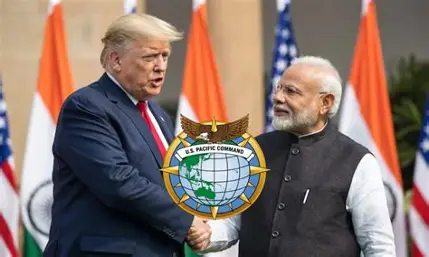
On 16 June 2026, the U.S. Department of War (the name the Pentagon has used alongside Department of Defense since September 2025) announced that U.S. Indo-Pacific Command (U.S. INDOPACOM) would revert to its historic designation, U.S. Pacific Command (U.S. PACOM). The command used the designation from 1947 until 2018. Although the announcement left the command’s operational mission unchanged, its timing invites comparison with the Trump administration’s December 2025 National Security Strategy (NSS). The NSS emphasizes burden-sharing and burden-shifting, reflecting Washington’s stated concern that the United States has carried a disproportionate share of global security responsibilities. Its treatment of India also warrants attention, particularly in comparison with the Biden administration’s 2022 strategy. However, differences in terminology alone cannot establish a decline in India’s strategic importance. The more consequential question is whether the administration’s emphasis on partner contributions signals a change in the expectations placed on New Delhi. Viewed in this context, the command’s renaming is a useful indicator of changing strategic messaging.
This article places the command’s restored designation alongside the Trump administration’s broader emphasis on burden-sharing. It argues that the reduced prominence of Indo-Pacific terminology may signal a change in Washington’s strategic messaging without necessarily indicating a corresponding decline in practical cooperation with India. For New Delhi, the central question is whether the relationship will increasingly depend on demonstrable contributions to regional security rather than on symbolic recognition alone.
America First 1.0: Coalition-Building as Strategy
During Trump’s first term, America First in the Indo-Pacific operated largely through coalition-building. The Free and Open Indo-Pacific (FOIP) vision and the May 2018 renaming of Pacific Command to Indo-Pacific Command formed part of that approach. Contemporary reporting described it as a deliberate “symbolic nod to India” at a moment when Washington was deepening logistics and technology cooperation with New Delhi. The change carried limited direct operational consequences but signaled greater incorporation of the Indian Ocean into U.S. strategic thinking. For India, however, the significance extended beyond nomenclature. India’s incorporation into the Indo-Pacific framework strengthened its visibility within regional architecture without requiring a formal alliance. The logic of this period was one of recognition and coalition-building. Washington sought capable partners within a shared regional framework, while India gained greater strategic visibility within it.
America First 2.0: Burden-Shifting as Doctrine
The December 2025 NSS argues that Washington has carried a disproportionate share of global security responsibilities and calls on partners to contribute more. The emphasis is therefore not simply on maintaining strategic alignment, but on what partners are expected to contribute to regional security. The Brookings Institution’s assessment that the Indo-Pacific receives relatively limited attention in the document raises a related question about the region’s place in Washington’s wider priorities. The Observer Research Foundation’s (ORF) discussion of the region’s limited treaty-alliance architecture further highlights the importance of cooperation arrangements that do not depend on formal mutual-defense commitments. For India, the key question is whether this emphasis will translate into greater expectations regarding maritime security, regional surveillance, and deterrence, particularly across the Indian Ocean.
India’s existing maritime activities provide one basis for assessing its potential contribution to regional security. Across the Western Indian Ocean, naval deployments and information-sharing with regional partners are relevant indicators, while the Indian Navy’s Information Fusion Centre – Indian Ocean Region (IFC-IOR) supports maritime-domain awareness. The India–U.S. Defense Acceleration Ecosystem (INDUS-X) provides a separate measure of progress in U.S.–India defense-innovation cooperation. Together, they show where a greater Indian contribution is most likely to be measured.
India’s capacity to assume greater maritime responsibility is constrained by competing security demands. New Delhi must maintain military preparedness along the Line of Actual Control (LAC) with China while sustaining naval deployments, surveillance, and regional engagement across a vast maritime area. Maintaining both commitments places demands on India’s defense planning and available forces. Any expectation that New Delhi should take on a larger maritime role must therefore be considered alongside its continuing military requirements along the LAC. The relevant question is whether India can sustain an expanded maritime role without weakening its land-border preparedness or compromising its preference for strategic autonomy.
Sarang Shidore of the Quincy Institute interprets the administration’s regional approach as placing greater emphasis on a narrower security architecture centered on the First Island Chain, Taiwan, and the South China Sea. Read alongside the NSS, this interpretation suggests a stronger focus on the First Island Chain than on the wider Indian Ocean–Pacific framework. The distinction matters for India because its maritime interests extend across the Indian Ocean as well as the western Pacific. Taken together, the NSS’s emphasis on burden-shifting, India’s reduced prominence in its text and its narrower treatment of the Indo-Pacific point to a change in priorities, though not yet to a wholesale change in U.S. operational commitments.
Read More: ASEAN and the South China Sea
The implications of the renaming must be assessed against the limits of what it demonstrates. The official announcement stated that the command’s area of responsibility and operational mission would remain unchanged. The memorandum distinguishes the public-facing use of “Pacific Command” from the command’s statutory designation. In other words, the administration’s preferred terminology has changed, but the command’s statutory designation has not.
The continuation of practical regional cooperation provides a further qualification. The Quad’s May 2026 launch of the Indo-Pacific Maritime Surveillance Collaboration indicates that cooperation on maritime surveillance and information-sharing continued around the time of the renaming. Continued cooperation of this kind is compatible with a shift toward burden-sharing. The initiative’s implementation, the contributions expected from each partner, and any changes in operational responsibilities would provide stronger evidence for assessing whether the distribution of regional security burdens is changing.
An analysis in Dawn treats the removal of “Indo” as symbolically significant because the 2018 designation had been associated with India’s growing importance to U.S. strategy. That reading captures the symbolism of the change, even if the operational picture has not yet shifted.
Implications for India: Why Capability Now Matters More Than Recognition
Under America First 1.0, India’s regional standing was reinforced by both its own initiatives and its growing visibility in U.S. strategic planning. New Delhi advanced initiatives such as SAGAR (Security and Growth for All in the Region), while Washington’s strategic vocabulary, defense-partner designation, and command nomenclature signaled India’s importance to the bilateral relationship. Under America First 2.0, the emphasis on burden-shifting may place greater weight on the practical contributions India can sustain, even as defense cooperation continues. However, India’s regional influence rests on more than U.S. recognition. Its geography, military capabilities, regional partnerships, and capacity to provide maritime security will remain important determinants of its strategic weight.
- Geography: India’s position along major sea lines of communication linking the Persian Gulf, East Africa, and the Malacca Strait provides a durable basis for maritime engagement, irrespective of changes in U.S. strategic terminology.
- Military capability: The Indian Navy’s expanding capabilities and experience in humanitarian assistance and disaster relief provide a foundation for regional maritime engagement, although the scale of its contribution remains constrained by available resources and competing security priorities.
- Regional initiatives: SAGAR and the MAHASAGAR framework articulate India’s ambition to contribute to regional security and development. Their strategic significance depends on implementation and the resources committed to sustaining these initiatives.
- Partnership diversification: India’s engagement with Gulf states, France, ASEAN members, and East African littoral states provides additional avenues for cooperation. The extent to which these relationships enhance India’s strategic flexibility depends on the depth and practical outcomes of that engagement.
For India, the implications of America First 2.0 lie less in the removal of a strategic label than in the possibility that Washington will place greater emphasis on reciprocal contributions. Maritime-domain awareness, operational coordination, and defense-industrial cooperation may become increasingly important measures of the partnership’s practical value. India’s geography and military capabilities create opportunities for regional influence. But New Delhi’s ability to sustain that influence will depend on the forces it can deploy and the commitments it can maintain alongside its land-border requirements. Strategic autonomy therefore remains important not as a rejection of cooperation with Washington, but as the capacity to determine which commitments serve India’s wider interests.
Read More: How the US-India Defence Pact is Fracturing BRICS
Conclusion
The restoration of the Pacific Command designation does not, in itself, demonstrate a change in the United States’ operational commitments to India. Its significance lies in how it can be read alongside the December 2025 NSS’s emphasis on burden-sharing and burden-shifting. Together, these developments raise questions about whether Washington’s strategic messaging is moving away from coalition-building toward greater expectations of partner contributions.
For India, the distinction between recognition and responsibility is increasingly important. Its regional influence cannot depend on U.S. terminology alone; it must be sustained through credible maritime capabilities, effective regional partnerships, and the capacity to contribute without compromising competing security priorities. The central challenge for New Delhi is not simply to respond to changing American signals, but to determine how far practical cooperation with Washington advances India’s own regional objectives while preserving its strategic autonomy.
Read More: Why Multilateralism Cannot Reform Itself
Sherzimah Akbar
Sherzimah Akbar is a researcher in international relations and strategic studies affiliated with the Institute of Strategic Studies Islamabad (ISSI). She holds a BS in International Relations from the International Islamic University Islamabad. Her researchfocuseson South Asian security, Indian foreign and defense policy, maritime security, and the Indo-Pacific, with particular interest in India’s strategic behavior and regional security dynamics. Her work examines India’s military modernization, maritime strategy,strategicpartnerships, and the evolving security environment in South Asia and the Indian Ocean Region.