A climate-resilient Pakistan cannot be designed by Islamabad alone, nor by provincial capitals that hold on to the powers local governments need to turn national plans into action. The climate hazards facing Pakistan are felt on the ground – from date farms in Sindh, to streets in Karachi under water, to mountain communities in Gilgit-Baltistan. While the federal government coordinates national priorities and international climate advocacy, provincial governments are accountable for turning those commitments into tangible action. Successful adaptation depends on predictable funding, strong institutions, and the meaningful engagement of the communities bearing the brunt of climate change.
National Ambition, Local Vulnerability
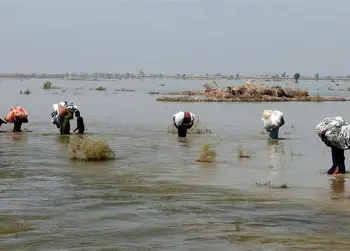
Pakistan contributes less than one percent of global greenhouse-gas emissions but remains highly vulnerable to climate-related disasters. Its National Adaptation Plan (NAP), published in 2023, records that the 2022 floods affected 33 million people and displaced eight million. These figures demonstrate how climate hazards can overwhelm livelihoods, infrastructure, and public services.
The NAP offers a pathway to build community resilience through fair use of resources, gender-responsive planning, transparency and inclusion. It also gives provincial and local governments the task of designing and carrying out adaptation measures in their areas. The problem, then, is not a lack of vision but that the institutions expected to deliver it lack the authority, resources and technical ability to do so. Climate change is not just a policy document. It is Tharparkar’s water stress, Badin’s coastal shocks, Karachi’s urban deluge and glacial risks in Gilgit-Baltistan. Local governments, district administrations and community organizations have to handle many of these direct effects.
Devolution Must Reach Beyond Provincial Capitals
Responsibility for this implementation gap cannot be placed entirely on Islamabad. The Eighteenth Amendment of 2010 devolved environmental responsibilities to the provinces. Provincial governments consequently have a central role in environmental policy and adaptation delivery. However, transferring authority from the federal government to the provinces does not automatically empower local institutions. As the Human Rights Commission of Pakistan’s analysis of local-government constitutional protections explains, Article 140A requires provinces to establish local-government systems and devolve political, administrative, and financial responsibility to elected local representatives.
The history of local government in Pakistan shows how hard it has been to devolve real power. Postponed elections, frequent changes to local systems and limits on the transfer of functions and budgets leave local governments dependent on provincial decisions. Decentralization therefore needs to be judged not only in Islamabad but also in the provincial capitals.
This matters. Local adaptation will be hard to achieve if the provincial government makes decisions but pushes the results down to local governments and districts to grapple with floods, heat waves and water shortages. The provincial government has to empower local action, not replace it.
Read More: Systems Thinking: Urban Development and Beyond
Heat Stress Shows Why Adaptation Must Be Local
The experience of date workers in Sindh illustrates the human consequences of this governance challenge. In an August 14, 2026, AFP report published by Malay Mail, workers in Khairpur described beginning their shifts around 2 a.m. to avoid the worst daytime heat. Temperatures reached 42°C, and workers reported heatstroke, fainting, and fever.
According to the report, Khairpur accounts for over half of Pakistan’s date production, and industry estimates cited in the report suggest that Pakistan typically earns over US$120 million a year from date exports. These conditions demonstrate how climate change affects employment, public health, and economic activity at the same time. A national plan can help recognize heat stress, but real protection comes from measures close to where people work and live: drinking water, heat alerts, suitable working hours, and access to healthcare.
A Swat apple farmer, a Lahore resident, and a Sindh coastal family encounter different mixes of risk. To be meaningful, adaptation has to reflect those differences rather than apply one-size-fits-all governance.
From Emergency Response to Preparedness
Pakistan has disaster-management institutions such as Provincial and District Disaster Management Authorities (PDMAs and DDMAs). But the presence of institutions is not enough; their mandates, resources and capacity are what matter. The National Adaptation Plan identifies weaknesses exposed by the 2022 floods, including poor coordination, unclear responsibilities, and limited capacity, particularly at subnational and local levels. It calls for stronger disaster-risk governance, improved early-warning systems, and investment in preparedness.
The Asian Development Bank’s Climate and Disaster Resilience Enhancement Program likewise places institutional capacity, resilience investment, and disaster-risk financing at the center of reform.
Local governments should not sit at the bottom of a top-down administrative ladder. They need clear accountability, revenue to protect critical infrastructure and maintain drainage and water systems, and the capacity to issue early warnings. Without genuine administrative devolution and predictable funding, national and provincial plans will be hard to deliver on the ground.
Match Local Responsibility with Finance and Expertise
Provincial governments should establish a predictable adaptation fund for local entities, prioritizing based on exposure, vulnerability and basic-service requirements. Investments eligible for support should include flood-resistant health facilities; sanitation and water management; and climate-smart, locally suited agriculture practices. Decentralization should come with accountability too. Funding decisions, project prioritization, implementation status and outcomes should be a matter of public record. Without transparency and accountability, decentralization would merely shift decision-making from one level to another.
Technical assistance is just as necessary. District administrations require environmental engineers, urban planners and climate finance specialists. In smaller municipalities, a provincial technical advisory team may be more effective than expecting each municipality to employ every type of specialist.
Finance Minister Muhammad Aurangzeb emphasized this problem in his March 21, 2025, remarks reported by Dawn News English. He argued that financing must be accompanied by capacity-building and technical assistance so Pakistan can prepare investable, bankable projects. International funding cannot deliver durable protection if institutions lack the ability to design, implement, and monitor adaptation investments.
Read More: The Strait of Hormuz Crisis and Its Ripple Effects on Pakistan
Put Communities at the Center
Local input ought to inform adaptation at all stages, from proposal through to monitoring and evaluation. Community insights can highlight issues with drainage, households at risk, water management practices and community groups beyond the reach of external planners. Local knowledge should be used alongside scientific data and technical skill. Women, minority groups, young people, and other vulnerable residents should have meaningful opportunities to influence decisions. The NAP’s stated goals explicitly connect resilience with progressive empowerment and gender-responsive, participatory, transparent, and socially inclusive approaches.
Pakistan does not need to abandon federal leadership. The federal government must work with the provinces to set the national ambition, advocate for climate justice and assist in attracting global support. The provincial governments must take the environment seriously and empower local institutions. The true test of climate policy is not how well it is written in a capital, but whether communities can act before harm becomes catastrophe. Pakistan will achieve resilience when the federal government keeps its promises, the provinces share power and money, and communities lead the charge.
Umer Fazeel
Umer Fazeel is an undergraduate student of Politics and International Relations at Albukhary International University, Malaysia. His interests include climate governance, international relations, geopolitics, development finance, and public policy, with a particular focus on Pakistan and South Asia. His work examines the relationship between climate change, governance institutions, international cooperation, and sustainable development. He has published commentary on Pakistan’s climate vulnerability in News Diplomacy and writes about policy challenges affecting Pakistan and the wider international community. His current interests include climate resilience, locally led adaptation, institutional accountability, and the role of international cooperation in addressing development challenges. Through his research and policy commentary, he aims to contribute to informed public debate and support practical, evidence-based approaches to governance and climate policy.